

 An exciting, cutting-edge contribution to the scholarly record—“Electrochemically Induced Deposition (ECiD) of Lithium Phosphate and the Effect of Reaction Parameters” by Ali Amir Saleh, Louis L. De Taeye, Sai Gourang Patnaik, Genis Vanheusden, and Philippe Vereecken—features in the March issue of ECS Advances.
Tailoring ECiD processes for desired outcomes
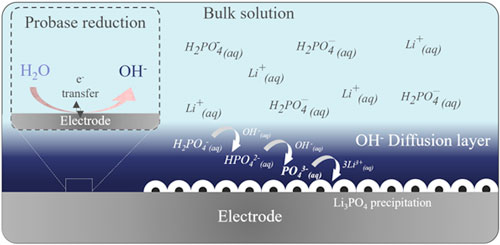
This open-access article dives into a versatile electrochemical approach for synthesizing thin films of lithium phosphate on conductive surfaces via electrochemically induced deposition (ECiD)—a method with broad relevance for materials that are traditionally challenging to deposit electrochemically. By combining experimental investigation with numerical modelling, the authors illuminate how reaction conditions like current density, pH, and electrolyte composition shape the deposition mechanism and resulting material morphology. Their insights advance understanding of how to tailor ECiD processes for desired outcomes, knowledge that will benefit researchers across electrochemistry, energy materials, and solid state science.
Advancing innovation
Contributions like this article showcase the depth and quality of research shared in ECS Advances, driving innovation in electrochemical and solid state science technologies forward. We encourage authors and readers to explore the rich content available in ECS Advances, cite impactful work like this one, and consider ECS Advances as a premier publishing home for their own electrochemical science discoveries.
Read the full article to dive deeper into this exciting work and join the growing community of researchers shaping the future of electrochemical technology.