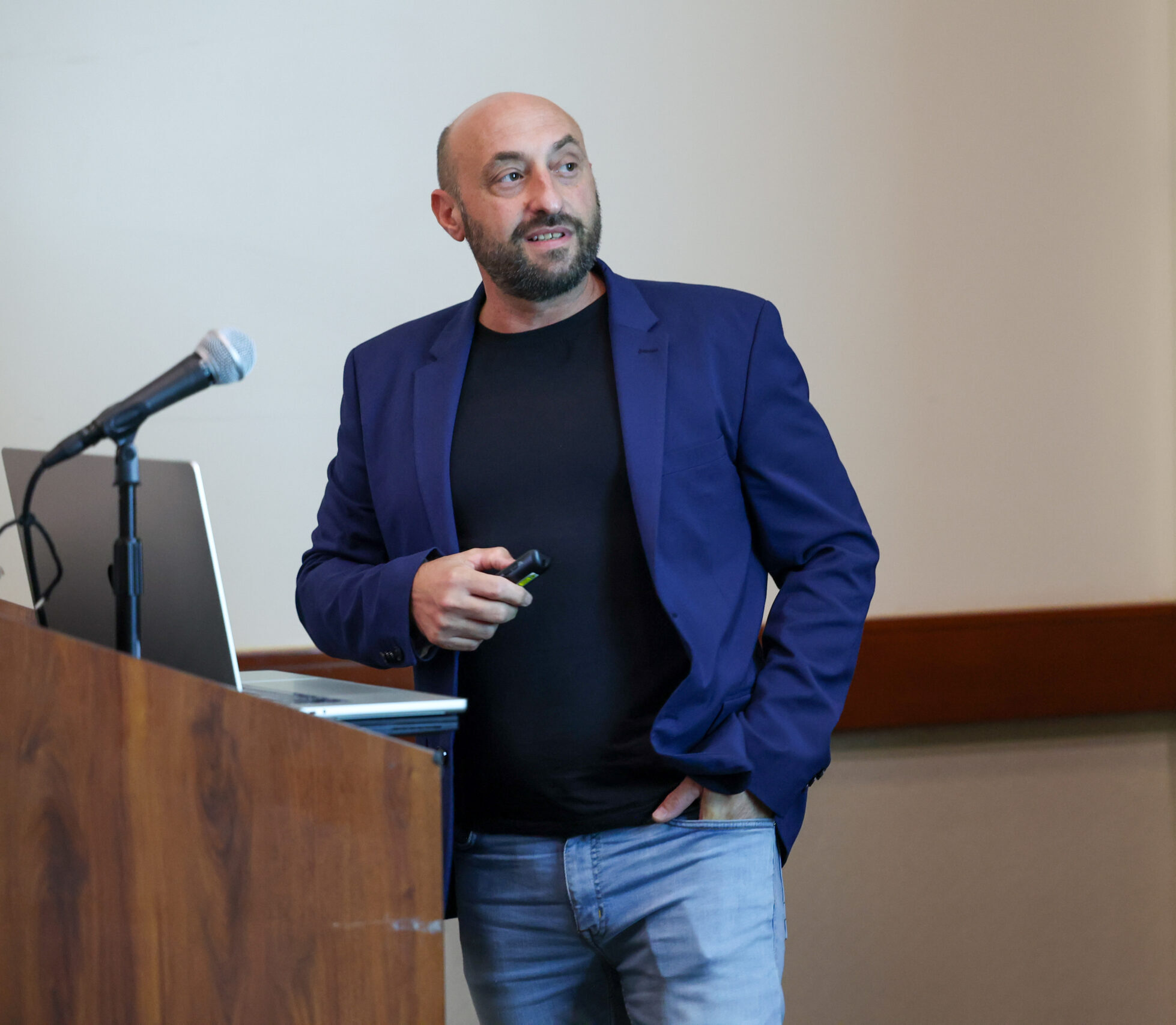
Noël Hallemans

Noël Hallemans

Noël Hallemans
University of Oxford

Date: January 21, 2026
Time: 1000–1100h ET

Register now


Electrochemical impedance spectroscopy (EIS) offers rich insights into the physical processes within batteries—but how can these measurements directly inform physics-based models? Recent work presented in this webinar demonstrates how impedance data can be used to extract grouped parameters for physics-based models such as the Doyle-Fuller-Newman (DFN) model or the reduced-order single particle model with electrolyte (SPMe). (more…)

Jeff Dahn

Jeff Dahn

The ECS Detroit Section invites you to “LFP Li-ion cells are boring – Why should I care?” presented by Jeff Dahn on January 13 at Nissan Technical Center North America.

Register now

(more…)

ECS Advances is pleased to highlight a recent article that makes an important contribution to the understanding of high-temperature electrochemical processes: “Evaluating Platinum, Gold, Glassy Carbon, and Graphite Anodes for Chlorine Evolution in Molten Calcium Chloride Salt.” Authored by Cameron Vann, Shelssie Klvacek, Carlos Mejia,  and Devin Rappleye, this work provides timely and practical insights into materials selection for chlorine evolution under extreme conditions.

The chlorine evolution reaction (CER) in molten calcium chloride (CaCl₂) carries several critical technologies, including chlorination, metal refining, rare earth processing, and the treatment and purification of used nuclear fuel. Despite its importance, long-term anode stability and performance in molten salt environments remain persistent challenges. This study directly addresses those challenges through a systematic comparison of four commonly considered anode materials: platinum, gold, glassy carbon, and graphite. (more…)

Alex PeroffToday’s guest post comes from Dr. Alex Peroff, Electrochemical Sales Scientist at Pine Research Instrumentation, an  ECS Institutional Partner, who shares his perspective on advancing research, collaboration, and innovation in our scientific community.

I attended the electrochemical education symposium at the 248th ECS Meeting in Chicago, IL. After listening to the talks, I was inspired to develop an abstract to present at a future meeting. The topic would either be about my efforts in teaching electrochemistry via YouTube or developing electrochemistry workshops. Not knowing which topic to pick, I decided to poll my LinkedIn network. To my surprise, only eight percent of people were interested in learning about making YouTube content, compared to 55 percent who were interested in electrochemistry workshops. (more…)

Volatile fatty acids (VFAs) from biomass fermentation offer a sustainable alternative to petroleum-based chemicals, serving as building blocks for bioplastics, pharmaceuticals, and more. However, separating and purifying these acids from fermentation broths remains technically challenging.

A new study in the Journal of The Electrochemical Society, selected as an Editors’ Choice article, addresses this bottleneck. Researchers Riccardo Candeago, Nidhish Lella, Wangsuk Oh, Ping Liu, and Xiao Su developed a physics-based model of redox-mediated (more…)

Today’s guest post comes from Lutz Stratmann, Senior Electrochemist, and Richard Newell, Marketing Specialist and Technical Writer, of ECS Institutional Partner PalmSens BV, who share their perspective on advancing research, collaboration, and innovation in our scientific community.

In developing the EmStat4T—our latest battery-powered potentiostat with a touchscreen and QR code reader—we wanted users to be able to make it truly their own. Customization often means writing scripts, but coding can be a major hurdle for many researchers. Our goal was clear: make scripting easier without sacrificing flexibility. (more…)

Today’s guest post comes from the Team at BioLogic, an  ECS Institutional Partner, who share their perspective on advancing research, collaboration, and innovation in our scientific community.

Electrochemical measurements are highly sensitive by nature and even small variations in wiring, shielding, cell design, or even signal processing can significantly impact data quality and lead to misleading results. To avoid common mistakes, it’s important to understand the best lab practices from the start. (more…)

We are pleased to spotlight a publication from the ECS Journal of Solid State Science and Technology (JSS):

“Low-Damage Atomic Layer Etching for Contact Resistance Reduction in Millimeter Wave AlGaN/GaN HEMTs on Si” (DOI: 10.1149/2162-8777/ae1ced) by Hsuan-Yao Huang et al. (2025) —available fully open access.

In this work, the authors address one of the key bottlenecks for high-frequency GaN electronics: ohmic contact resistance and accompanying device damage in high-electron-mobility transistors (HEMTs) built on Si substrates. Conventional etching methods for the ohmic-recess process often introduce plasma-induced damage, rough surfaces, and degraded channel performance. (more…)

ECS Sensors Plus is pleased to highlight a recent contribution that showcases the power of material innovation in enhancing electrochemical sensing technologies. In their new article, “Application of a g-C₃N₄@nZVI/CNTs Modified Carbon Paste Electrode for Uric Acid Detection in Spiked Urine Samples,” Aya A. Mouhamed, Ola G. Hussein, Maria Osama Mekhail, Tony Victor Zaki, Amr M. Mahmoud, and Jeffrey G. Bell present a promising approach for accurate, sensitive uric acid detection.

The research team developed a carbon paste electrode modified with a uniquely engineered g-C₃N₄@nZVI/CNT nanocomposite. By combining graphitic carbon nitride’s high surface area, nano zero-valent iron’s catalytic activity, and carbon nanotubes’ conductivity, the authors created a synergistic platform capable of boosting electron transfer and improving analytical performance. (more…)

The Electrochemical Society (ECS) seeks nominations for the position of Technical Editor for the Sensors topical interest area within the Journal of The Electrochemical Society (JES).

The Technical Editor plays a critical leadership role in maintaining JES’s reputation for publishing high-quality, peer-reviewed research that advances the frontiers of electrochemical science and technology. (more…)

  • Page 1 of 312
ECS
Privacy Overview

This website uses cookies so that we can provide you with the best user experience possible. Cookie information is stored in your browser and performs functions such as recognising you when you return to our website and helping our team to understand which sections of the website you find most interesting and useful.