

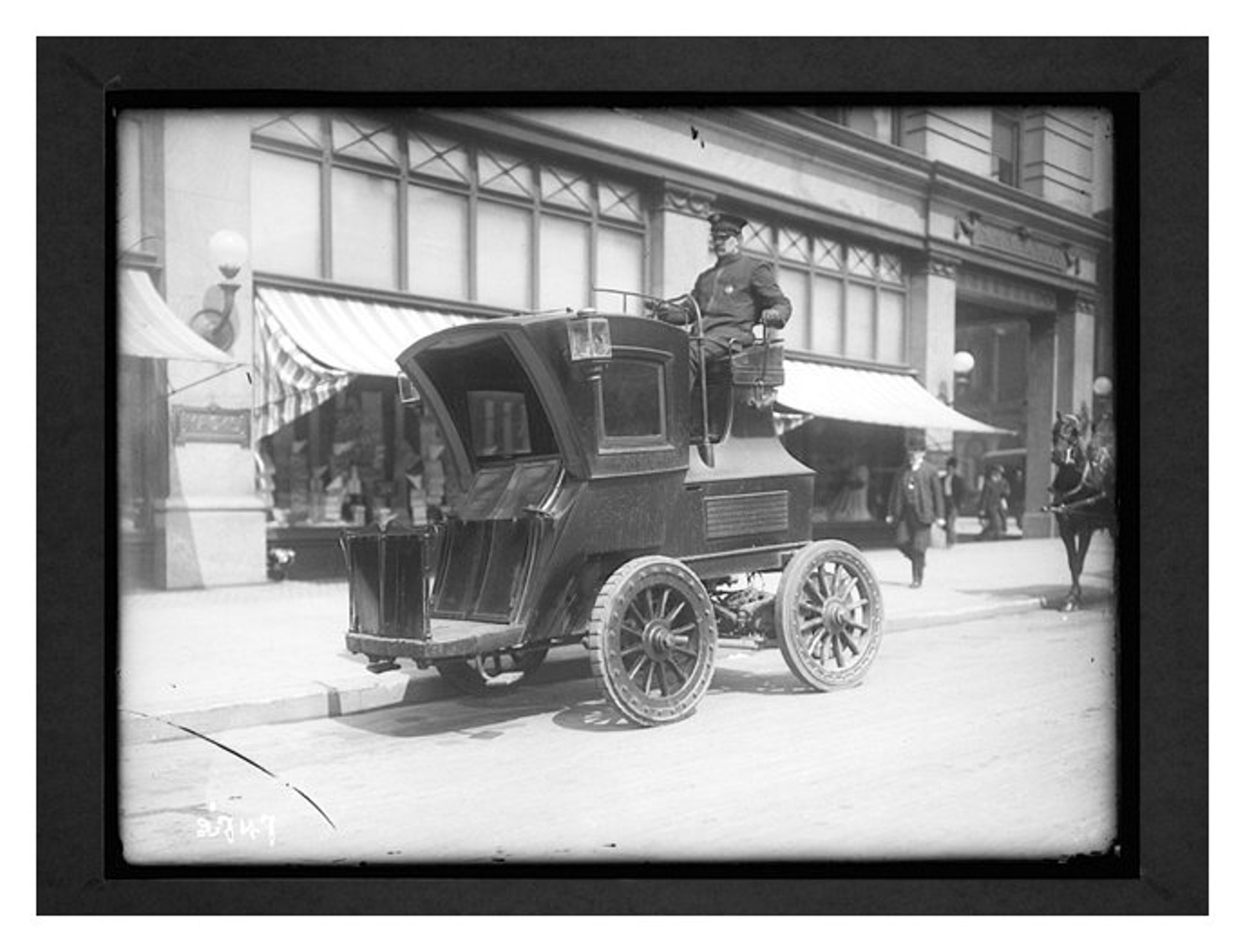
An Electrobat cab
A brief history of the first ECS Meeting
The newly formed American Electrochemical Society (which would become The Electrochemical Society) held its first meeting from April 3–5, 1902.* Earlier, Charles John Reed III, an independent electrochemistry consultant, had proposed creating a new electrochemistry section of the American Chemical Society (ACS). When ACS dragged its heels, Reed appealed to Joseph W. Richards, Professor of Metallurgy at Lehigh University, who agreed to become involved. Reed, Roberts, Carl Hering, E. F. Roeber, Samuel P. Sadtler, and William H. Wahl sent 30 letters to engineers, chemists, and scientists, which said:
“The rapidly growing importance of the subject of electrochemistry and the want of suitable occasions in this country for the discussion of papers and questions pertaining thereto by those specially interested have suggested the advisability of founding a National Electrochemical Society…”1
The organizers decided that they couldn’t proceed without at least 75 members. A second letter solicited charter members, explaining that “The bringing together in this way (meetings) of those engaged in the scientific study of electrochemistry, and the practical engineers and pioneers of the industry will be of inestimable value to both.”2 To qualify for charter membership, the member had to be interested in electrochemistry and pay a $5 membership fee. A total of 337 paid the $5 dues to become charter members, and 87 registered for the initial meeting.
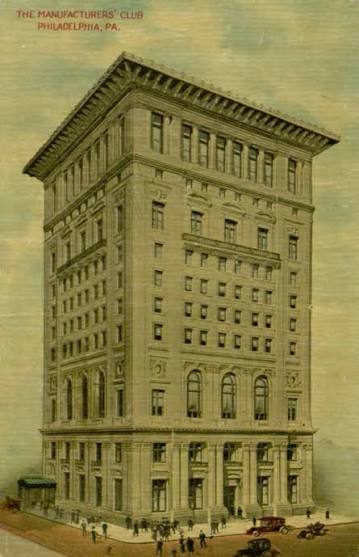
The Manufacturers Club in Philadelphia, PA, was the site of the Society’s inaugural meeting. Attendees at that first meeting—and the many thousands who attended the subsequent 249 Society Meetings—have demonstrated that those gatherings are indeed of “inestimable value.” The accomplishment of 250 meetings over 124 years will be celebrated at the 250th ECS Meeting in Calgary, Canada, from October 25–29, 2026.
The first order of business at the 1st ECS Meeting was a motion to organize the American Electrochemical Society, which passed unanimously. (The word “American” was dropped from the Society’s name in 1930.) Other important business was determining how the word “electrochemistry” should be spelled. The vote was 29–25 against spelling it “electro-chemistry.”
The Society then held its first election. Along with the president, treasurer, and secretary, six vice presidents (three more than we have in 2026!) and eight “managers” were chosen.
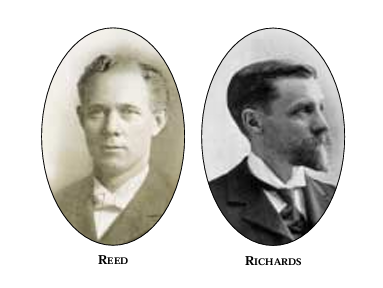 Who were the Society’s “founding leaders”?
- Richards, who had been acting chairman, was elected president. The son of a man who had apprenticed under George Stephenson, the engineer who developed the first commercially viable steam locomotives and public railways, Richards was best known for his Treatise on Aluminum, published in 1887.3
- Reed, who was elected secretary, filed numerous patents and published technical papers that shaped early battery technology, electrical engineering, and magnetic separation. He worked with Thomas Edison in 1890.4
- Pedro G. Salom was elected treasurer (a position he held for 20 years). An independent inventor, entrepreneur, and executive, Salom cofounded the Electric Carriage and Wagon Company in 1897 with Henry G. Morris.5 The first electric vehicle company in the U.S., they operated 12 electric handsome cabs called “electrobats” in Manhattan.6
 Twenty technical talks were presented at the University of Pennsylvania, spanning subjects including:
- “A New Zinc Bromide Storage Battery”
- “The Continuous Electrolysis of Solutions of Metals”
- “The Electrolytic Rectifier”
- “The Nascent State”
- “The Electrolytic Refining of Composite Metals”
- “A Novel Concentration Cell”
- “Current Electrochemical Theories”
Preprints of the technical papers were available before the meeting. While presenting pre-published papers didn’t allow for the presenting of recent results, it did lead to lively discussions. Lawrence Addicks (who was only 24 years old at the time of the first meeting) is reported to have said, “We—I in particular—did not know too much of what we were talking about, but papers and their authors were certainly kicked around and even when licking your wounds you knew you had learned something.” Addicks, a Massachusetts Institute of Technology graduate, was a metallurgist who specialized in nonferrous metallurgy and copper refining. He later served as a consulting engineer on the Naval Consulting Board (1914–?) and became vice president of the Cerro de Pasco Corporation, a U.S. syndicate founded in 1902 to mine in Peru, that included J.P. Morgan, Henry Clay Frick, and Darius Ogden Mills.7
Talk lengths ranged from five to 30 minutes. Herbert H. Dow, who went on to found the multinational conglomerate Dow Chemical, was allotted only five minutes, while Richards had 30 minutes to speak on a “University Course in Electro-chemistry,” a topic still discussed at today’s meetings.
University of Wisconsin Prof. Louis Kahlenberg’s challenge to Svante Arrhenius‘ groundbreaking ionization theory—which had been proposed three decades earlier—was presented. Kahlenberg summed up these thoughts in a 1904 paper, “The facts that flatly contradict the hypothesis are now so numerous that its doom is sealed.”8 Arrhenius won the Nobel Prize in Chemistry in 1903. Kahlenberg went on to serve as Society President (1930–1931).
After the technical sessions concluded, attendees visited the Bethlehem Steel Company, Lehigh Zinc Works, and Lehigh University, setting the precedent for site visits linked to Society meetings.
The American Electrochemical Society’s constitution called for publishing meeting papers and the ensuing discussions. The Society’s second leg—publications—was established with the launch in July 1902 of Transactions of the American Electrochemical Society, which contained the first meeting’s papers and discussions.
Charter members of the new Society were residents of 35 states, the District of Columbia, and eight foreign countries, foretelling the broad reach of today’s global Society. From 20 technical papers presented before an audience of 52 attendees to thousands of presentations shared by researchers from around the world, the ECS Meeting has evolved dramatically over the past 124 years. Yet its central purpose remains exactly as its founders envisioned: bringing together the scientific community to exchange ideas, challenge assumptions, and advance electrochemical and solid state science.
*GENERAL ECS HISTORY SOURCES
- Forest A. Trumbore, and Dennis R. Turner, The Electrochemical Society 1902–2002, A Centennial History, The Electrochemical Society, 2002
- Robert M. Burns, and Ernest G. Enck, A History of The Electrochemical Society 1902–1976, The Electrochemical Society, Inc., 1977, 4
- “The Electrochemical Society, A Forum for Electrochemistry and Solid-State Science for 100 Years,” Interface Special Centennial Issue: ECS at 100, 2002 Soc. Interface 11 1DOI 10.1149/2.20021IF
- “The Electrochemical Society: The First Hundred Years, 1902 – 2002,” The Electrochemistry Encyclopedia, reprint, August 4, 2026, https://knowledge.electrochem.org/encycl/art-e04-echem-soc.htm
- “History of ECS,” The Electrochemical Society, August 3, 2026, https://www.electrochem.org/history-ecs
- “History of ECS Publications,” The Electrochemical Society, August 4, 2026, https://www.electrochem.org/history-publications
NOTES
- Burns and Enck, History, 4
- Burns and Enck, History, 5
- “Joseph W. Richards Collection,” Lehigh University, August 3, 2026, https://archivesspace.lib.lehigh.edu/repositories/3/resources/306
- “Charles John Reed Collection, 1862-1976,” Calisphere University of California, August 3, 2026, https://calisphere.org/item/a0db075a79a0619bea18f5c37465b443/
- “Lead Reduction Company signed by Pedro G. Salom cofounder of the First U.S. Electric Car – 1904,” Scripophily.com, August 3, 2026, https://scripophily.net/electrical-lead-reduction-company-signed-by-pedro-g-salom-co-founder-of-the-first-u-s-electric-car-1904/
- Rive Cadwallader, “The Great Electrobat,” The Woodlands, August 3, 2026, https://www.woodlandsphila.org/blog/2016/1/22/the-great-electrobat
- “Lawrence Addicks Papers,” MIT Libraries MIT Archives Space, August 3, 2026, https://archivesspace.mit.edu/repositories/2/resources/889#:~:text=Biography,the%20Cerro%20de%20Pasco%20Corporation.
- The early thoughts about Arrhenius’ theory that Kahlenberg brought to the first Society meetings were published in 1904 as “The Theory of Electrolytic Dissociation,” Science, Vol. 20, No. 509, 1904, 535.