
Presenters:
Lena V. Buehre (Bühre)
Gottfried Wilhelm Leibniz Universität Hannover
Kentaro (Ken) U. Hansen
National Laboratory of the Rockies
Date: November 18, 2026
Time: 1000–1100h ET
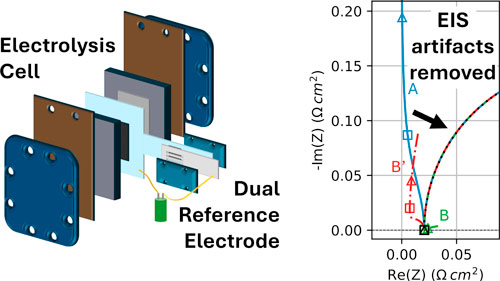
Reference electrodes (REs) are a great tool to better understand processes in electrolysis cells at each electrode. By combining the use of REs with electrochemical impedance spectroscopy (EIS), we can analyze and assign overpotentials and degradation processes to specific electrodes. However, REs are tricky to place into a cell with a solid electrolyte and are subject to other constraints, including the need to accommodate pressurized gases and maintain adequate geometric clearance. Also, EIS measurements are easily affected by perturbations and noise which can lead to uninterpretable results. This is especially difficult when using reference electrode setups.
The webinar introduces the benefits of reference electrodes in different electrolysis applications, along with possible setups and representative cases. An exemplary setup for a PEMWE is then selected, and EIS results demonstrating these perturbations and noises are presented. Finally, a method for filtering the signal and removing artefacts from the EIS results is proposed.
Attend this webinar to learn about
-
An overview of reference electrodes in electrolysis cells;
-
An understanding of the challenges associated with EIS in these setups;
-
An introduction to a potential method for filtering signals in EIS measurements.
Presenters
Kentaro (Ken) Hansen and Lena Bühre published a short communication on this topic during their postdoctoral research at National Laboratory of the Rockies (formerly known as NREL). They both came with experience in reference electrodes (Lena in PEMWE, Dr. Hansen in CO2RR) and EIS measurements. Besides these efforts, they collaborated in the H2NEW consortium where they worked on anode catalyst development, degradation, and for electrochemical characterization in segmented cells for PEMWE.
Lena Bühre is a junior research group leader for Electrochemical Energy and Material Conversion at the Gottfried Wilhelm Leibniz Universität Hannover and habilitation candidate. She received her PhD in Engineering from Leibniz in 2024.
Kentaro (Ken) Hansen is now working in advanced diagnostic tools for CO/CO2RR devices as a Postdoctoral Research in Chemical Engineering at NRL. He completed his PhD in Chemical Engineering at the University of Delaware in 2024. .
Thank you to the sponsors who make these complimentary programs possible!
 |
 |
 |
Interested in presenting in the ECS Webinar Series? Email your presentation title and abstract to education@electrochem.org for consideration.