
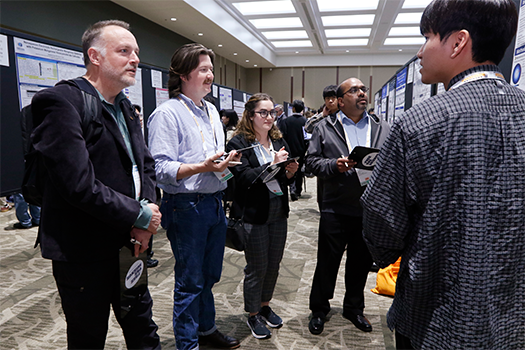
 Why serve as a poster competition judge for an ECS biannual meeting? And what can student poster presenters learn from the judges’ perspectives? We posed these questions to several judges of the Z01 General Student Poster Competition judges to gain insight into why volunteering as a judge is a rewarding experience and what makes a standout poster.
Established in 1995, the Z01 poster session gives graduate and undergraduate students a forum to present research of general interest to the ECS community. Its goals are to foster and promote work in electrochemical and solid state science and technology while encouraging active student interest and participation in the Society. Any student who enters a poster is eligible to compete for one of three awards (provided they meet a few submission requirements).
But the awards are only part of the story. As the jurors’ insights reveal, the competition offers valuable opportunities for both presenters and judges.
Words of Wisdom from the Judges
Why volunteer to judge posters?

Alice Suroviec
ALICE SUROVIEC, Dean of Berry College’s School of Mathematical and Natural Sciences and Professor of Bioanalytical Chemistry, has organized the Z01 General Student Poster Competition since October 2019. Her answer: “Make a difference beyond the lab! Serving as an ECS poster competition juror is an opportunity to recognize promising research, encourage emerging scientists, share your expertise, and discover innovative work shaping the future of electrochemical and solid state science. Your time and perspective can make a lasting impact on the next generation of researchers.”
What first led you to become a poster competition judge?
JEFFREY HALPERN, Professor of Chemical Engineering & Bioengineering at University of New Hampshire, responded, “I was asked, and I was looking to get more involved. Sometimes it is the simple things. But I also enjoy interacting with the students and coaching them on ways they can think about their experiments, data, and presentation. The Z01 session should be about the growth and encouragement of students and celebrating the wide variances of their progression through their professional journey. “

Scott Calabrese Barton
SCOTT CALABRESE BARTON, Professor of Chemical Engineering and Materials Science at Michigan State University, also said, “I was asked!” He went on, “Seriously, poster or session organizers are always on the lookout for judges. Whenever someone asks me to judge posters, I almost always say yes if I don’t have a conflict.”
What have you learned or gained from the experience of judging?
JEFFREY: “Sometimes the best experience is the interactions and conversations with fellow judges. They have been exceptional individuals, also caring about the growth and progress of students. We have had interesting conversations about how/when to give feedback to students so it is heard and understood. There have also been a few posters that have been exceptional at expanding the understanding of my own work. Unfortunately, I do not think those posters won (awards), but I made sure the presenters knew how exceptional and impactful their presentations were.”

Maureen Tang
What do you find most rewarding about serving as a judge; what is most challenging?
MAUREEN TANG, Associate Professor of Chemical and Biological Engineering at Drexel University, replied, “I enjoy meeting students and seeing them get excited about their projects. It’s challenging to follow some of the technical details because the projects vary so widely and many students are still learning how to introduce a project to someone who is not deep in the weeds every day like they are.”
SCOTT: “I most enjoy interacting with the poster presenters. It’s always better if the presenter is at the poster when I visit; I like to hear their take on their research and get their answers to my questions. The challenging part is usually time. The posters I see are often very high quality and I would most enjoy spending more time with the presenter and learning more about the research. However, I typically have a deadline to meet when I’m judging, so I have to move on more quickly than I’d like.”
Share a memorable experience from a poster competition you participated in; what made it meaningful to you?

Jeffrey Halpern
JEFFREY: “I never did a poster for the national ECS Z01 session; however, a memorable positive experience was a local poster presentation. In my final PhD year, I presented my ‘thesis on a page’ where I was able to walk through key theories and results. I was very proud of that work.”
What would you say to someone who is considering becoming a judge for the first time?
JEFFREY: “It only takes a few hours, and I wouldn’t hesitate. If you are there to see the newest things being developed, if you are there to engage with the younger scientists, if you are there to learn, the poster session is a great way to do all three.”
Words of Wisdom for Poster Presenters
What separates a good poster from an exceptional one?
JEFFREY: “Here are some tips I share with my students:
- Have a single take away message that can be explained in one minute or less. Then make sure every word and figure on your poster supports that message.
- Make sure you have a clearly stated objective, hypothesis, result, and conclusion that is almost repetitive. These should be consistent with each other and flow together.
- When you can, use a figure instead of a paragraph or explanation.
- Take your time with the figures, as they can take as much time to generate as the text of a paper.
- White space is your friend and can also guide the audience.
- For the competition, sometimes it is about the impact, sometimes about the quality of your work, and sometimes luck. Many factors influence the outcome, so don’t let not winning negatively affect your research.”
What makes a poster or presentation stand out to judges?
SCOTT: “Standout posters excel in three areas: an interesting and unique idea, a well conceptualized approach, and a presentation that includes effective text and graphics to convey the idea, the approach, and the results.”
What are some common mistakes you see in poster presentations?
JEFFREY: “Here are a couple common errors I have seen:
- Too much text on the poster (although this is a stylistic thing).
- Including figures or material collected by someone else if you’re less familiar with or less confident discussing them. You need to own and support everything on your poster.
- Speaking hesitantly or without confidence. Practice your presentation until you feel confident discussing your research but avoid rehearsing to the point that it sounds like a polished, uninterrupted speech. A poster presentation should be a conversation supported by visuals.”
SCOTT: “Be present at your poster as much as possible and ask questions to gauge your audience’s understanding. Beyond that, feel free to convey your excitement about your research, which is contagious.”
How do you approach evaluating posters when the research topics vary widely?
SCOTT: “I look for an effort to explain the topic in a way that most ECS attendees can understand. This requires presenters to know their audience and tailor their explanations accordingly. Asking questions to gauge the audience’s understanding is also a valuable communication skill.”
What advice would you give someone preparing for their first poster competition?
MAUREEN: “One of the most important rules of communication is to consider your audience, and posters are a great example of why that matters. I recommend approaching a poster presentation as a conversation rather than a recited speech. The worst experience is when a student launches into a six-minute memorized explanation of every figure on the poster. The best is when a student starts by asking, ‘Before I begin, what do you know about this topic?’ From there the student can guide the discussion through the motivation, methods, and results, skipping what the audience already knows and spending more time explaining unfamiliar fundamentals. This approach helps me learn something new, gives students practice explaining their research to a variety of audiences, and makes for a really fun conversation.”
SCOTT:
- “Review posters you admire, particularly past award winners. What makes them stand out and what can you learn from them?
- Ask advisors and mentors to review your poster and recommend improvements. Great posters go through multiple rounds of revisions.
- Use high resolution graphics.
- Spellcheck!
- Prepare a concise, approximately five-minute overview of your research. Practice your presentation before the event.”
Present. Engage. Learn.
Ultimately, the best poster presentations go beyond communicating research findings—they engage the audience and make complex ideas accessible. As one experienced poster judge explained, the key is to make the presentation a conversation, not a speech.
There’s still time to submit a poster abstract for the 251st ECS Meeting, taking place May 30–June 3, 2027, in Washington, DC. Submit your abstract by December 4, 2026!
Volunteer. Evaluate. Inspire.
Serving as a poster judge is an opportunity to support the next generation of researchers while gaining fresh perspectives on emerging work across the field. It also offers a chance to encourage students, share your expertise, and contribute to the welcoming, collaborative atmosphere that makes ECS meetings valuable.
Interested in getting involved? Contact Alice Suroviec. As she puts it, “I’d love to bring new judges into Z01 and welcome someone to help coordinate the event schedule. This is a great opportunity to share leadership, involve more members, and build a stronger team for the future.”