
It’s election season! Help shape the future of our organization.
(Click to enlarge)
It’s that exciting time of year again—officer elections are here! As members of our organization, we all share a responsibility to shape its future.
Why Your Vote Matters
Elections aren’t just about titles—they’re about vision and leadership. The officers you elect:
- Set the tone for our community and events;
- Oversee major initiatives and projects;
- Represent our organization’s values and goals;
- Support members and foster collaboration.
Your participation helps ensure that every voice is heard and that our leadership reflects our community’s diverse perspectives.
Voting period: January 15 to March 15, 2026
Be sure to mark your calendars!
Positions up for election
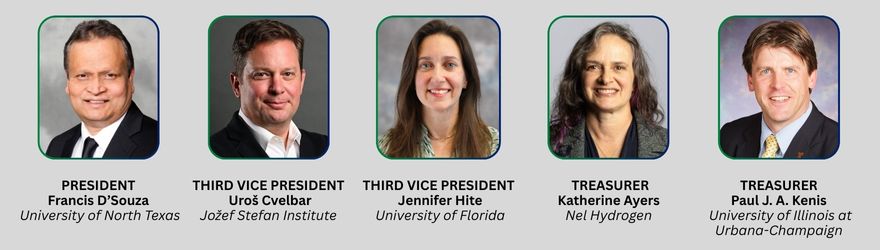
This year, we will elect officers for these roles:
- President – Ensures that ECS acts as a conscientious steward of the science, and that the Society’s programs and activities serve to advance the ECS mission.
- Vice President – Supports the president and provides leadership and direction for the Topical Interest Areas and vital functions of ECS.
- Treasurer – Responsible for the transparency and compliance of the Society’s financial affairs, ensures the future vitality of ECS through the efficient use of its financial resources, and ensures that resources are allocated to support activities that advance the ECS mission.
Each position plays an essential role in keeping our organization thriving.
Let’s lead the way together
Elections are more than a process; they’re an opportunity for renewal, creativity, and collaboration. Whether you’re running for office or casting your vote, your involvement makes a difference.
Read each candidate’s biography and candidacy statement below, followed by voting instructions.
Candidate for President
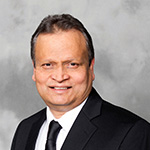
Francis D’Souza
Francis D’Souza
Francis D’Souza is Regents Professor of Chemistry and Materials Science and Engineering at the University of North Texas (UNR) and is also part of UNT’s Applied Materials and Manufacturing Processing Institute. His principal research interests include supra and nanomolecular chemistry of photosensitizer-carbon nanomaterials, advanced functional materials for light energy harvesting and photovoltaics, electrochemical and photochemical sensors and catalysts, and nanocomposite hybrid materials for energy storage and utilization.
Dr. D’Souza received a PhD from the Indian Institute of Science, Bangalore and held postdoctoral positions at the University of Houston and Université de Bourgogne (Dijon). Before joining UNT in 2011, he was Professor of Chemistry at Wichita State University (WSU). Dr. D’Souza has authored over 560 publications, given over 450 conference talks, and edited 10 Handbooks on Carbon Nanomaterials, resulting in over 25,000 citations with a cumulative h-index of 80.
His honors and awards include Fellow of The Electrochemistry Society; Fellow of the Royal Society of Chemistry; Fulbright Specialist Scholar; American Chemical Society Doherty Research Award; ECS Nanocarbons Division Robert C. Haddon Research Award; UNT Foundation Eminent Scholar, Research Leadership and Toulouse Scholar Awards, and Regents and Distinguished Professorships; Chemical Research Society of India (CRSI) Medal; Global Initiative for Academic Network (GIAN) Fellow, Government of India; Japan Society for the Promotion of Science Fellow; and WSU Excellence in Research and Young Investigator Awards.
As an active member of The Electrochemical Society since 1993, Dr. D’Souza has served the Society at many levels. An ECS board member from 2004 to 2008 and 2022 to the present, he is now Senior Vice President. A Member at Large of the ECS Nanocarbon Division, he has served as its Chair, Vice Chair, Secretary, and Treasurer. As Nanocarbon Division Chair, he was instrumental in establishing and securing endowment funds for the ECS Nanocarbons Division Richard E. Smalley Research and SES Research Young Investigator Awards. He currently chairs the Technical Affairs Committee and to date, he has co-organized more than 45 symposia for the Society’s fall and spring meetings. For the last 10 years, Dr. D’Souza has been a Technical and Associate Editor for the Journal of Solid State Science and Technology.
Statement of Candidacy
It is my great honor to be a candidate for President of The Electrochemical Society. Electrochemical science and technology now play a vital role in our modern life; examples include the production of renewable energy, energy storage, corrosion prevention, pollution control, sensors and biosensors, and greenhouse gas reduction, to name a few. Electrochemical science is also at the forefront of offering large-scale solutions to meet the challenges of climate change and global warming. If elected ECS President, my mission will be to establish stronger collaborative relationships among scientific communities, promote young scientists, help develop clean energy technologies, and bridge the gap between academia, industry, and policymakers. ECS is my home society where I have met many peers and friends, which has greatly nurtured and influenced my career. I will continue to serve ECS and its members and staff constructively, collaboratively, and respectfully, and look forward to the possibility of doing so in the highest leadership role.
Candidates for Third Vice President
Uroš Cvelbar

Uroš Cvelbar
Uroš Cvelbar is Professor of Nanotechnology at the Jožef Stefan Postgraduate School and Head of the Department of Gaseous Electronics at the Jožef Stefan Institute, Slovenia’s largest research institute. He has dedicated his career to researching innovative and sustainable technologies, and leading plasma-driven science, pioneering work in plasma nanotechnology, electrochemistry, and nanomaterials for applications in energy, sensing, and biomedicine. Over the course of two decades, his research has led to important innovations in plasma-enabled nanomaterial synthesis, energy storage, and environmental technologies, which have been transferred to industry and helping to drive the green transition. As one of the founders of plasma nanoscience and plasma electrochemistry, he has authored more than 250 peer-reviewed publications and holds 20 patents.
Prof. Cvelbar received his PhD in Materials Science from the University of Ljubljana in 2005. He has held visiting positions in Australia, China, France, India, and the US, and has actively contributed to international scientific communities. A highly active Society member since 2008, he is a Fellow of The Electrochemical Society, an ECS Life Member and an ECS Europe Section member, and he has served in different leadership roles in the ECS Dielectric Science and Technology Division and on numerous ECS committees. Prof. Cvelbar currently serves on the Honors & Awards Committee and Individual Membership Committee. His achievements have been recognized with multiple awards, including the 2023 Zois Recognition Award; 2011 Slovenian Puh Award for Outstanding Achievements; Erudite Professorship (Kerala, India); as well as three Slovenian Excellence in Science Awards and fellowships from the European Academy of Sciences and Arts (EASA), World Academy of Art and Science (WAAS), and The Club of Rome.
Candidacy Statement
It is my great honor to be nominated for the position of 3rd Vice President of The Electrochemical Society. For more than a century, ECS has advanced knowledge at the intersection of science, technology, and society. Today, as we confront unprecedented global challenges—climate change, resource scarcity, energy transitions, digital transformation, and the call for a more equitable world—our community has never been more vital in this rapidly changing world.
My vision is to see ECS lead as a global platform for solutions. The discoveries and technologies we foster are central to building a sustainable and just future: from energy storage that enables a carbon-free economy, to electrochemical pathways for clean manufacturing, to sensors that safeguard health and the environment, and similar solutions. These are not just scientific achievements; they are contributions to the resilience and well-being of humanity.
As 3rd Vice President, I would champion three aspirations. First, to position ECS as a driver of systemic transformation, aligned with the values of the United Nations Sustainability Development Goals—placing science at the service of peace, sustainability, climate action, quality education, and human dignity. Second, to expand inclusivity and diversity, ensuring that voices from all regions and backgrounds have equal opportunity to shape our Society and the future of science, making it a truly global community. Third, to foster transdisciplinary collaboration, linking wet and dry sides in the same direction and vison, and strengthening partnerships with industry and policymakers so that our research directly informs real-world solutions and makes an impact.
ECS has long been my scientific home, shaping my career and global collaborations. I believe it is our responsibility to ensure that ECS continues to inspire not only scientific excellence but also a sense of purpose: that through our science, we are building a world that is sustainable, inclusive, and peaceful. Together, we can make ECS the place where visionary ideas converge to address humanity’s grand challenges. ECS is the place where knowledge becomes impact, and impact becomes legacy, and everyone is welcome to join the effort.
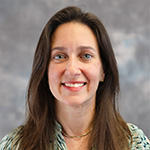
Jennifer Hite
Jennifer Hite
Jennifer Hite is Professor of Materials Science and Engineering at the University of Florida (UF). Her research focuses on the growth and characterization of wide and ultrawide-bandgap semiconductors, with an emphasis on applications in power electronics.
Prof. Hite received her BS in Chemical Engineering and earned her PhD in Materials Science and Engineering (2006) at the University of Florida. Prior to her PhD studies, she worked at Lucent Technologies. In 2007, she was an ASEE Postdoctoral Fellow at the U.S. Naval Research Laboratory, transitioning to permanent staff as a Karles Fellow in 2010, then Senior Materials Research Engineer. She joined the UF faculty in 2024. The author or co-author of over 190 publications and 300 presentations, she holds eight patents.
Prof. Hite has been active in ECS since her first presentation as a graduate student at the 210th ECS Meeting in Cancún, Mexico, in 2006. Since then, she has organized or co-organized more than 20 ECS symposia on solid state topics and has served the Society in many roles. For the past eight years, she has been an ECS Electronic and Photonics Division (EPD) Executive Committee member, including 2nd Vice Chair and Division Chair. She chaired the Interdisciplinary Science and Technology Subcommittee (ISTS) for the last three years, overseeing the expansion of the committee’s role in symposium organization and championing a push into multidisciplinary symposia addressing resiliency issues. Through her roles with EPD and ISTS, she has been on the Board of Directors, Technical Affairs Committee, and Symposium Planning Advisory Board. Supporting the organization in publications, Prof. Hite served as division representative on the ECS Interface Advisory Board and guest edited a Journal of Solid State Science and Technology focus issue and ECS Interface issue.
Candidate Statement
When I first presented my research at the 2006 Joint International ECS Meeting, I was a grad student, unsure of my footing. The experience that truly resonated was the warmth that followed me after the session: colleagues who listened, offered constructive feedback, and lifted a rookie into confidence. That moment embedded in me the sense that ECS was more than a society—it was a professional community that invested in its members from day one. Over the years, among the societies I have engaged with, ECS has been a constant point of return. Its welcoming culture, ease of meaningful interaction, and breadth of topics have turned my involvement into a natural home base. Each meeting has brought new partners, fresh projects, and a deeper commitment to the mission of disseminating electrochemical and solid state science.
Our mission—to foster research, nurture dialogue, and accelerate the flow of knowledge—rests on collaboration. As ISTS Chair, I saw firsthand how bringing representatives from all divisions together sparks acceleration. If chosen as 3rd Vice President, my focus will be on building and strengthening those collaborations—both inside ECS and with other societies. Resilience, a theme that cuts across chemical manufacturing, recycling, monitoring, and energy conversion, offers a unifying narrative that can read across electrochemistry and solid state science. I plan to initiate cross‑division projects that have historically operated in silos, creating integrated pathways for innovation.
At the same time, I plan to bolster our engagement with solid state science. As ISTS Chair, I identified champions who successfully launched two multidisciplinary symposia—neuromorphic computing and sustainability in semiconductors—demonstrating that progress thrives when we tap into the Society’s diverse expertise. I will work with the divisions and publication committees to translate the energy of those symposia into focused journal issues that capture the dynamism of emerging fields.
During her tenure as ECS President, Geraldine Botte started forging closer relationships with societies in South and Central America. ECS President Turgut Gür and CEO Chris Januzzi did the same with our sister societies in Asia. I would like to continue this trend, not forging new paths, but strengthening the ones that have already been started.
As we are all very aware, the research funding environment is tightening. In addition to advocating for federal support, the Society can provide real value by forging stronger industry partnerships, creating new channels for collaboration and career development for our members.
Being considered for this role is a deep honor. I look forward to serving a community that advances scientific rigor, drives cross‑disciplinary innovation, and supports every member in making a lasting impact.
Candidates for Treasurer
Katherine Ayers
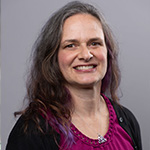
Katherine Ayers
Dr. Katherine Ayers is Senior Vice President of Research and Development for Nel Hydrogen US, focused on onsite hydrogen generation via water electrolysis. Her 30+ years of technical expertise includes batteries, fuel cells/electrolyzers, and solar cells. She has been with Nel since 2007 and manages a broad portfolio of internally and externally funded research projects, across a range of collaborators in academia, industry, and national labs. Her team is also responsible for supporting Nel’s electrolyzer cell stack product—launching new designs and supporting existing designs. Dr. Ayers has served on scientific advisory boards and committees, including the Joint Center for Artificial Photosynthesis (JCAP), the Energy Innovation Hub funded by the U.S. Department of Energy (DOE), and multiple Energy Frontier Research Centers and similar consortia. She has participated in expert panels for the DOE and the National Academy of Sciences (NAS) and served on two federal-level advisory committees for DOE.
Dr. Ayers has received numerous awards including 2012 and 2021 R&D Awards from the DOE Hydrogen Production Team, an American Chemical Society Women Chemists Committee 2014 Rising Stars Award, and a Fuel Cell Seminar Program Award in 2015. She was named Fellow of The Electrochemical Society in 2020 and awarded the inaugural ECS Walter van Schalkwijk Award for Sustainable Energy Technology in 2022. A member of ECS for over 25 years, she participated in several committees and symposia. Dr. Ayers chaired the ECS Energy Technology Division from 2023 to 2025 after serving as Member at Large, Treasurer, Secretary, and Vice Chair. In June 2025, she represented ECS with Chris Jannuzzi and Jim Fenton at a Capitol Hill science advocacy day in collaboration with the Materials Research Society (MRS).
Candidacy Statement
I am highly honored to be a candidate for ECS Treasurer. Shortly after I started my professional career in industry, I became involved with ECS and consider it my scientific home. I believe a good mix of industry, academic, and national lab members are needed to maintain ECS as a strong and vibrant technical society, especially in the current US environment of science skepticism among the general population. Personally, I have a large electrochemistry network across these areas and know the value each sector brings. Student members and junior scientists, as well as international representation, are also essential to bring diverse energy and new viewpoints. Continued support of student chapters, diverse symposia (including ISTS-sponsored symposia), and continuing education in electrochemistry and electrochemical engineering are important components in achieving these goals.
In my role at Nel Hydrogen, I have been largely responsible for not only overseeing our research and development efforts, but also for interacting with government agencies and Congress, especially prior to Nel hiring a full time Government Affairs lead. As such, I see the importance of engaging with staffers on both sides of the aisle to advocate for government support of science and engineering, in understandable and quantifiable terms. Our sister societies such as MRS, AAAS, and ACS all have activities in this area, and I was happy to represent ECS this spring in DC. At the same time, I have experience as a department head in responsible budgeting and reporting, and in stretching dollars to get things done.
If elected Treasurer, I will bring these skills, in collaboration with the ECS Executive Committee, to serve the Society and support the challenges we face as scientists.
Paul J. A. Kenis
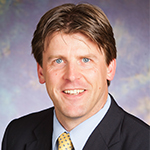
Paul J. A. Kenis
Paul J. A. Kenis is Professor of Chemical and Biomolecular Engineering at the University of Illinois Urbana-Champaign (UIUC) where he holds the Elio E. Tarika Endowed Chair. He is Director of the School of Chemical Sciences, after serving for 11 years as Head of the Chemical Engineering Department. He also holds an affiliate appointment with the International Institute for Carbon Neutral Energy (I2CNER) at Kyushu University.
Prof. Kenis’ research pursues a variety of projects in the area of electrochemical engineering, often related to electrifying chemical manufacturing using renewable feeds such as CO2, air, flue gasses, and biomass (e.g., crude glycerol). Specific efforts include CO2 or CO reduction, glycerol valorization, as well as ammonia oxidation and water electrolysis for hydrogen transportation/production. Earlier, he worked extensively on microfuel cells, including membraneless fuels cells (which led to a startup company, INI Power Systems, Inc.), and electrochemical flow reactors. A second research area pertains to the autonomous/automated synthesis, purification, and characterization of inorganic nanomaterials, including quantum dots and electrocatalysts.
After receiving a BS in Chemistry from Radboud Universiteit Nijmegen and PhD in Chemical Engineering from the Universiteit Twente, Prof. Kenis completed a postdoc at Harvard University focusing on microfluidics and microanalytical systems. Since joining UIUC in 2000, he has trained more than 40 PhDs and 120 undergraduates, many of whom have gone on to successful electrochemistry careers in industry, academia, and national labs.
The author of over 220 publications and 14 patents, Prof. Kenis is coauthor of reports on the prospects of CO2 utilization at scale issued by the US National Academies, Royal Society, and global Mission Innovation consortium. A Fellow of The Electrochemical Society and the International Society of Electrochemistry, some of his most recent recognitions include the ECS Carl Wagner Memorial Award, ECS Energy Technology Division Research Award, and Institution of Chemical Engineers Industry Project Award. Earlier, he received an NSF CAREER award and 3M Young Faculty Award.
Prof. Kenis’ varied service with the Society includes organizing more than two dozen symposia, judging PEMFC student poster competitions, and sitting on various division subcommittees. Since 2020, he has served as Secretary/Treasurer, Vice Chair, and presently Chair of the ECS Industrial Electrolysis and Electrochemical Engineering Division, Member at Large of the ECS Energy and Technology Division, and member of the ECS Finance Committee (2024-2026). Prof. Kenis guest edited the Electrochemistry for a Sustainable World special issue of ECS Interface in fall 2020, and today is the Journal of The Electrochemical Society Technical Editor for Electrochemical Engineering.
Statement of Candidacy
We live in a time when the central role of, and appreciation for, science and engineering is under pressure. Continued advocacy to the general public as well as to our representatives will be crucial to convey science and engineering’s importance to a safe and healthy world, as well as the central role electrochemistry plays in moving toward a sustainable society. As an elected board member, I certainly will seek to play an active role in this regard.
A major duty of the Treasurer is monitoring the Society’s finances and working closely with staff and leadership to insure the Society’s long term vitality. As past Head of Chemical Engineering and current Director of the School of Chemical Sciences at the University of Illinois, I have experience in budget management and planning. Through serving as Secretary/Treasurer, Vice Chair, and Chair of the ECS Industrial Electrolysis and Electrochemical Engineering Division (IE&EE), and especially by currently serving on the ECS Finance Committee, I have developed a clear understanding of how the Society operates and seeks to sustain financial health. As Treasurer, I will work with ECS staff and board members to keep a close eye on the Society’s finances in a time when costs seem to be growing faster than revenue. Our membership has a long history of sprouting exciting ideas and initiatives to advance the Society’s mission. I believe we can continue to pursue such ideas, even in challenging financial times, provided careful projection and monitoring of costs and benefits take place before and during their deployment. I plan to continue the practices instituted by current Treasurer Podlaha of summarizing and communicating in great clarity the Society’s financial state to the ECS board and its membership overall.
A few specific aspects warrant current attention. Over the next few years, the Society will need to evaluate carefully the effects of the new division funding model implemented last year. First signs are that a few adjustments may be warranted to ensure that all the divisions can continue to thrive in their programming and other efforts, despite their differences in scope, size, and/or practices. Second, the Society maintains a robust Society- and division-level awards program to recognize some of the most remarkable achievements in the realm of electrochemistry research, education, and societal impact, and/or service to the Society. These awards are funded in a variety of ways ranging from income from endowments to direct giving. Sustaining these awards for years to come may require some adjustments, be it the pursuit of dedicated fundraising efforts for specific awards or exploring adjustments in the way endowments associated with certain awards are handled, possibly allowing them to grow with the market. This is an area where my prior experience with alumni and corporate fundraising as Head of Chemical Engineering at UIUC may come in handy.
ECS has been my home society for well over two decades, not just as a forum to report our research outcomes through its meetings and journals, but also by offering a stimulating environment to identify new directions and meet new collaborators, colleagues, and friends. Now that my term as IE&EE Chair is coming to an end, I believe that if elected, I can continue to serve ECS as Treasurer, leveraging my past and current experiences. As your Treasurer, it will be my honor to serve you and to work with you to help sustain the Society’s financial vitality, as well as advance our professional field to the benefit of society in an ever-changing world.
Electronic Voting Instructions
 *Before voting, ensure that:
- Your ECS membership is current;
- You only have one ECS account;
- You selected a primary division.
Proceed to the electronic proxy ballot here and follow these easy steps to cast your votes:
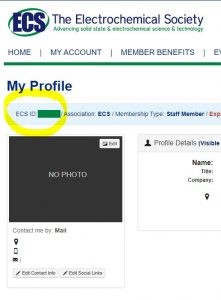
- Enter your ECS member number and password. To find your ECS member number, log into your ECS My Account. (Highlighted in yellow below).
- If you have trouble logging in to the system, contact customer service.
- After you log in, the electronic proxy ballot appears. Enter your vote for each office. Space is provided if you choose to write in a candidate.
- You can only vote once.
- Voting only takes a few minutes.
— Voting deadline: March 15, 2026, at 1259h EST —

We have an outstanding slate of officers. Exercise your membership privileges by voting today! Your input on ECS leadership counts.