

(Click to enlarge)
Recent advances in III-nitride heterostructures continue to push the boundaries of high-frequency and high-power device performance. A new study, “Demonstrating the Effects of Growth Temperatures of Al(In)GaN Back Barrier on Transport Properties of InAlGaN/GaN Heterostructures,” takes a close look at how carefully tuning growth conditions can directly shape electronic behavior at the nanoscale.
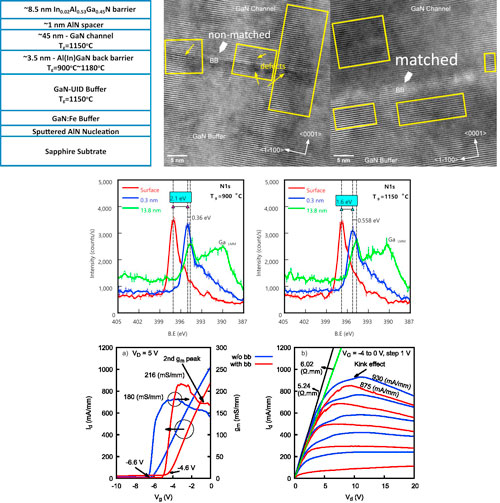
In this article, the authors—Hoang-Tan-Ngoc Nguyen, Rahul Rai, Quoc-Huy Nguyen, Quoc Viet Hoang, Ngoc Quang Huy Dinh, Chan-Yuen Chang, Chien-Wei Chen, You-Chen Weng, Hao-Chung Kuo, Ching-Ting Lee, and Edward-Yi Chang—investigate how the growth temperature of an Al(In)GaN back barrier fabricated using metal-organic chemical vapor deposition (MOCVD) influences the structure and performance of InAlGaN/GaN heterostructures. By minimizing the temperature gap between the channel and back barrier layers, the researchers achieved highly coherent growth with smooth surfaces, sharp interfaces, and no detectable threading dislocations. These structural improvements translated into measurable performance gains: higher electron mobility, reduced sheet carrier density, and stronger electron confinement.
Beyond materials quality, the device-level implications are striking. The optimized back barrier produced a positive shift in threshold voltage, increased maximum transconductance, and suppressed the kink effect—key indicators of improved stability and efficiency. Together, these results point toward meaningful opportunities for advancing high-frequency electronic applications using Al(In)GaN back barriers.
This article offers valuable insights for researchers working in wide-bandgap semiconductors, epitaxial growth, and next-generation electronic devices. Readers interested in nitride heterostructures, transport phenomena, and device optimization will find this study especially compelling.
Explore the full article, which is published open access in the ECS digital library, and discover how growth temperature engineering can unlock new performance regimes. This and many other cutting-edge studies can be found in the ECS Journal of Solid State Science and Technology, where innovative research in solid state science and applied materials continues to shape the future of electronics.