


Saad Azam
Saad Azam
Dalhousie University
Date: October 14, 2026
Time: 1300–1400h ET
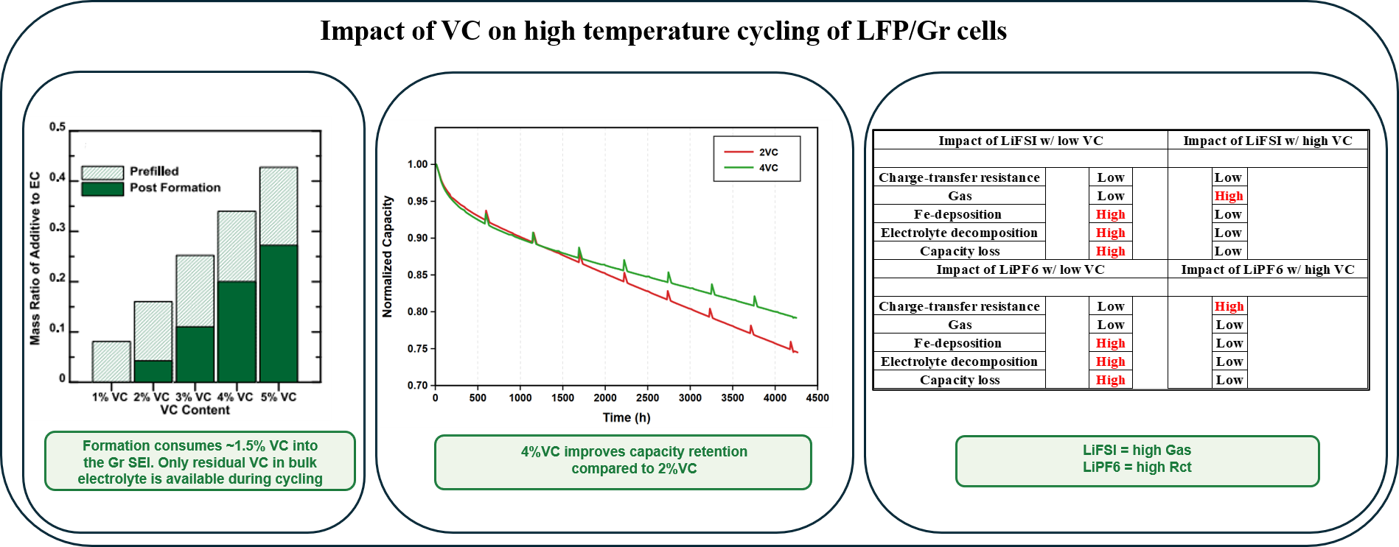
With the growing adoption of LiFePO4 (LFP)/Graphite (Gr) cell chemistry in electric vehicles and grid energy storage, understanding and enhancing its performance under high-temperature conditions has become increasingly critical. In this study, various concentrations of vinylene carbonate (VC) (1% to 5%) were introduced to LFP/Gr pouch cells cycled at 70 °C to evaluate their impact on cell lifetime. Additionally, two different lithium salts, LiFSI and LiPF6, were investigated. Upon reaching the end of life (80% capacity retention), detailed postmortem analyses were performed, including qNMR and GC-MS to determine changes in electrolyte composition, micro X-ray fluorescence (μXRF) to quantify Fe deposition on the negative electrode, and electrochemical impedance spectroscopy (EIS) to assess charge-transfer resistance. Various LFP/Gr pouch cells were evaluated, encompassing four distinct graphite types, two LFP surface area variations, and two cell form factors. The results demonstrate that higher VC concentrations significantly improve cell lifetime, reduce Fe dissolution, and suppress electrolyte degradation pathways, including the formation of ethyl methyl carbonate (EMC) and dimethyl 2,5-dioxahexane carboxylate (DMOHC). Furthermore, while LiFSI-based LFP/Gr cells exhibit enhanced performance in certain metrics, they suffer the production of gas at 70 °C, which can be mitigated by incorporating LiPF6 salt.
Benefits of attending this webinar:
Learn about:
- Why do LFP/graphite cells fail at high temperatures?
- What electrolyte degradation reactions occur at the graphite surface?
- How does excess VC improve cell lifetime at high temperatures?
Presenter
Saad Azam is a battery scientist whose research focuses on improving the lifetime, safety, and performance of lithium-ion batteries for electric vehicles and grid energy storage. He completed his PhD at Dalhousie University in the Jeff Dahn Research Group, where his work centered on electrolyte additives, high-temperature degradation, transition-metal dissolution, gas evolution, and long-term cycling of LFP/graphite and NMC/graphite pouch cells. His research combines electrochemical testing with advanced postmortem methods, including qNMR, GC-MS, EIS, and micro X-ray fluorescence, to connect cell performance with chemical degradation mechanisms. His recent work in the Journal of The Electrochemical Society examines how higher concentrations of vinylene carbonate improve the lifetime of LFP/graphite pouch cells cycled at 70 °C.
Thank you to the sponsors who make these complimentary programs possible!
 |
 |
 |
Interested in presenting in the ECS Webinar Series? Email your presentation title and abstract to education@electrochem.org for consideration.