

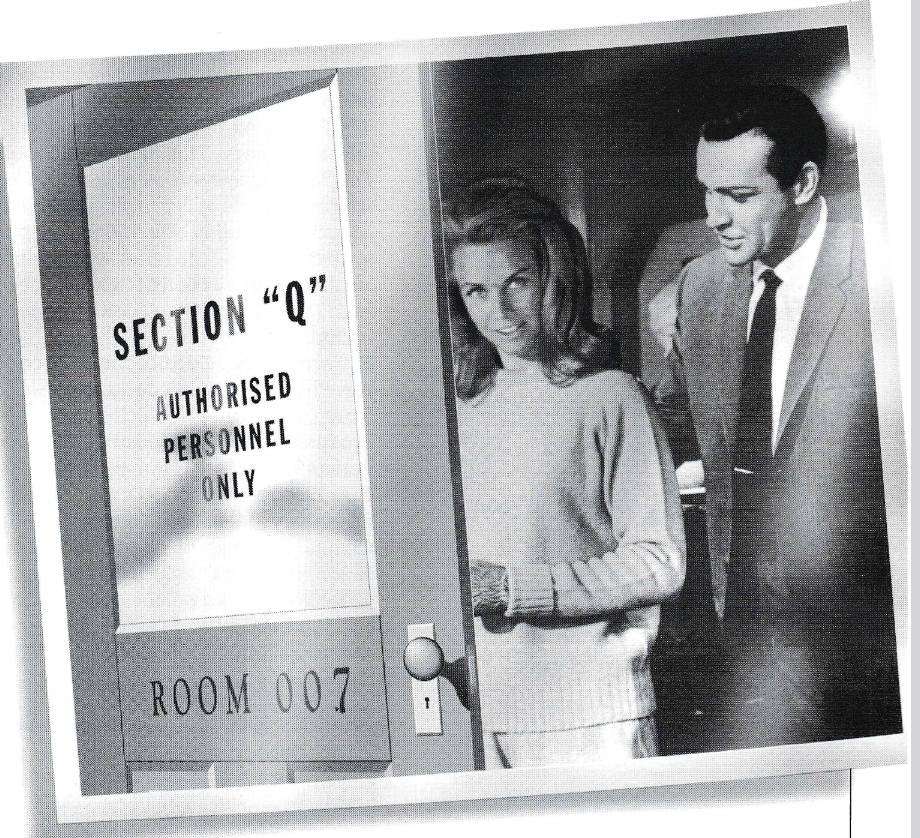
 Section Q: The Electrochemical Society’s Secret Society of Shenanigans
250 meetings over 124 years; that’s a lot of gatherings and a lot of science. But it wasn’t all work. Here are some memorable examples of some of the entertainment that meeting participants enjoyed.*
Section Q hatches
In 1907, The Electrochemical Society (ECS) agreed that sections should give members opportunities for “having papers read and discussions on technical subjects.” The earliest sections formed in Philadelphia, New York City, and Madison, WI. But not every section was interested in technical discussions.
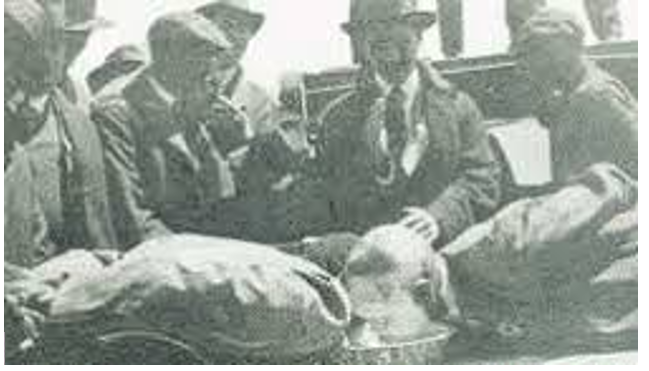
Dunking for apples at an ECS event
Around 1910, ECS leaders—including William Lash Miller (ECS President, 1912–1913)—formed Section Q,1 an unofficial organization devoted to friendship, humor, pranks, poetry, songs, and “spirituous beverages.” Its members gathered around formal meetings to socialize and stage elaborate pranks, often targeting the Society’s most distinguished scientists. The group’s sense of humor was often rooted in the very science practiced by its members.
At the 15th ECS Meeting in Niagara Falls, Canada, in 1909, Section Q reportedly planted a carborundum arrowhead2 for Willis Whitney to find. The founder of General Electric’s Research Laboratories, he was an avid collector of Native American artifacts. The 17th ECS Meeting in Pittsburgh, PA, in 1910, featured a “Smoker”3 with entertainment by Section Q. Miller led a candlelit procession to a laboratory, accompanied by bagpipers. And at the 19th ECS Meeting in New York, NY, in 1911, the group arranged for two New York City police officers to accompany a pair of hired vaudeville actors in staging a mock raid on a technical session at the Chemists’ Club.
Section Q’s antics continued for decades. Members turned their scientific subjects into satirical songs and poetry. As the group operated outside the official Society structure, much of its work was never recorded, leaving only glimpses of its exploits in later recollections.4
During Prohibition, its gatherings became legendary for their conviviality, especially those outside the US. At the 42nd ECS Meeting in Montréal, Canada, in 1922, Section Q was rumored to have stolen a speaker’s notes. The members then watched the resulting developments “while oxidizing alcohol.”
By the 1920s, Section Q had developed its own traditions and terminology. Members could be elevated to suitably grandiose titles. Frank Austin Lidbury (ECS President, 1914–1915) issued an invitation to a Section Q social event at the 55th ECS Meeting (1929, Toronto, Canada) under the name of Sir Austin Lidbury KQ (Knight of Section Q). The gathering was reportedly a particularly “spirited affair,” much appreciated by visitors from the United States.
A Tradition That Lives On
Section Q may have been unofficial, but its spirit survives. In a recent video, Nobel laureate and longtime ECS member M. Stanley Whittingham recalls an unforgettable meeting event that Section Q would certainly have envied. At the 141st ECS Meeting in Houston, TX, in 1972, where he received the Society’s Norman Hackerman Young Author Award, a poolside reception took an unexpected turn when real-life Texas Rangers law enforcement officers rode in on horseback!
ECS Meetings continue to provide opportunities today for members to connect beyond the technical program—including through “It Could Be Verse: An Evening of Poetry and More.” Debuting at the 244th ECS Meeting in 2023, the event brought members together to share poems, songs, music, and humor.
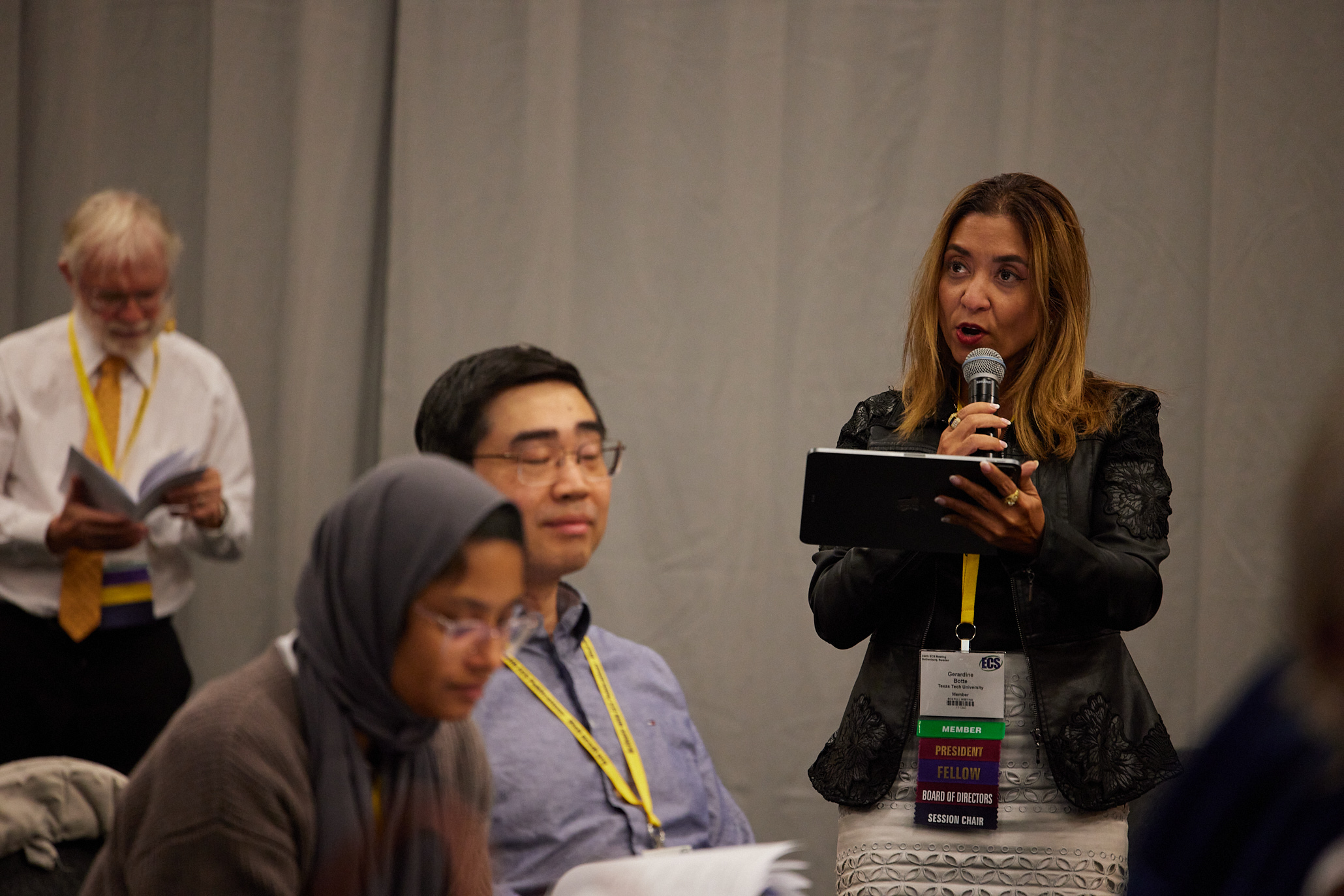
“It Could Be Verse” debuts at the Gothenburg, Sweden Meeting
The third “It Could Be Verse: An Evening of Poetry” takes place at the 250th ECS Meeting Celebration in October 2026 in Calgary, Canada. There’s an open call for participants to recite or read a poem, sing, or play music—no prior experience is necessary or expected. To participate, email organizer Noel Buckley. He shares his 50+ year commitment to ECS—and incorporating fun into the meetings—in a recent video.
More than a century and many meetings later, ECS meetings continue to bring together researchers, students, educators, and industry professionals from around the world. The science may have changed dramatically since Lash Miller’s day, but the need to step away from the technical program, share a laugh, tell a story, and enjoy the community of fellow scientists? That part of the ECS tradition lives on.
FOOTNOTES
1) Supposedly, the “Q” designation was chosen because the Society organized its technical sessions alphabetically (Section A for Batteries, Section B for Electrodeposition, etc.)—a tradition that continues today—and the founders thought Q was far enough down the alphabet that it wouldn’t be confused with an official scientific section.
2) Always on-trend, early ECS Meetings featured “Smokers”—informal parties where men gathered in hotels, clubs, guild halls, and universities to smoke pipes, cigars, and cigarettes while drinking and discussing politics or current events. Professional and amateur musical performances as well as comic acts and speeches were usually part of the entertainment. Smokers originated in England and became popular in the United States at the end of the 19th and early 20th centuries, particularly at universities. “The Aroma of the Music and the Fragrance of the Weed: Music and Smoking in Victorian England” (https://www.academia.edu/4248802/_ Lietuvos_muzikologija_Lithuanian_Musicology_vol_12_2012_pp_8_27, accessed 8/31/2026)
3) During a picnic in the Niagara Gorge, Whitney (ECS President, 1911–1912) discovered what appeared to be several genuine arrowheads until he finally discovered the one made of carborundum. The joke was particularly well chosen. Carborundum—silicon carbide—had been discovered in 1891 by Edward Goodrich Acheson, ECS’s sixth president, while he was experimenting with electricity, clay, and coke in an attempt to produce artificial diamonds. Acheson’s discovery would become one of the Society’s most significant early technological achievements.
4) Lawrence Addicks, who served as ECS President from 1915–1916, later recounted several of the group’s exploits in his address at ECS’s 50th Anniversary Meeting in Philadelphia in 1952. See Lawrence Addicks, “The Founders,” Journal of The Electrochemical Society, January 1952, 99(1), 5C–8C.
*GENERAL ECS HISTORY SOURCES
Special thanks to John Lewis for his in-depth introduction to the ECS archives and the secret history of Section Q.
- Forest A. Trumbore, and Dennis R. Turner, The Electrochemical Society 1902–2002, A Centennial History, The Electrochemical Society, 2002
- Robert M. Burns, and Ernest G. Enck, A History of The Electrochemical Society 1902–1976, The Electrochemical Society, Inc., 1977, 4
- “The Electrochemical Society, A Forum for Electrochemistry and Solid-State Science for 100 Years,” Interface Special Centennial Issue: ECS at 100, 2002 Interface 11 1DOI10.1149/2.20021IF
- “The Electrochemical Society: The First Hundred Years, 1902 – 2002,” The Electrochemistry Encyclopedia, reprint, August 4, 2026, https://knowledge.electrochem.org/encycl/art-e04-echem-soc.htm
- “History of ECS,” The Electrochemical Society, August 3, 2026, https://www.electrochem.org/history-ecs
- “History of ECS Publications,” The Electrochemical Society, August 4, 2026, https://www.electrochem.org/history-publications
- Harold J. Read, “ECS Classics: Section “Q” Recalled,” 1994 Soc. Interface 3 17DOI 10.1149/2.F02944IF