By: Jeff Inglis, The Conversation
Editor’s note: The following is a roundup of archival stories. 
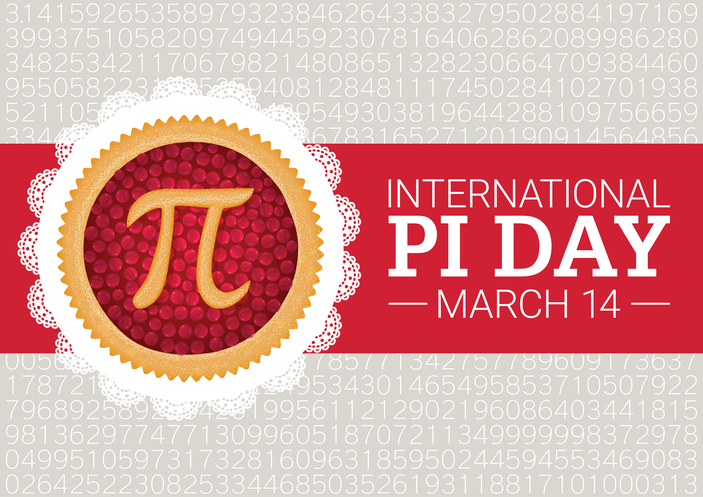 On March 14, or 3/14, mathematicians and other obscure-holiday aficionados celebrate Pi Day, honoring π, the Greek symbol representing an irrational number that begins with 3.14. Pi, as schoolteachers everywhere repeat, represents the ratio of a circle’s circumference to its diameter.
What is Pi Day, and what, really, do we know about π anyway? Here are three-and-bit-more articles to round out your Pi Day festivities.
A silly holiday
First off, a reflection on this “holiday” construct. Pi itself is very important, writes mathematics professor Daniel Ullman of George Washington University, but celebrating it is absurd:
The Gregorian calendar, the decimal system, the Greek alphabet, and pies are relatively modern, human-made inventions, chosen arbitrarily among many equivalent choices. Of course a mood-boosting piece of lemon meringue could be just what many math lovers need in the middle of March at the end of a long winter. But there’s an element of absurdity to celebrating π by noting its connections with these ephemera, which have themselves no connection to π at all, just as absurd as it would be to celebrate Earth Day by eating foods that start with the letter “E.”
And yet, here we are, looking at the calendar and getting goofily giddy about the sequence of numbers it shows us.

 “The
“The 
 As millions of students of all ages return to school this fall, they are making important choices that have a strong influence on their eventual career path – which college majors to pursue, which high school classes to take, even which elementary school extracurricular activities to join. Many of them – especially women, girls and members of minority groups – make choices that lead them away from professions in the fields of science, technology, engineering and mathematics (STEM).
 On March 4, 2017, ECS will be celebrating