
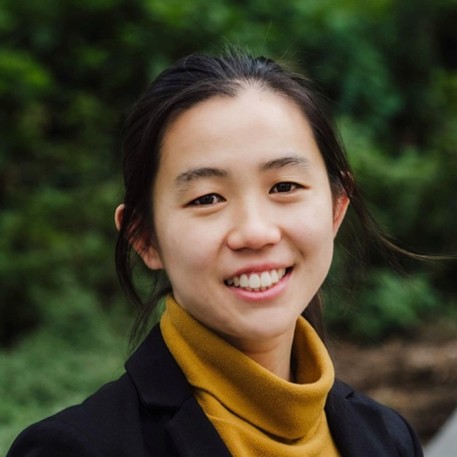
Joy Zeng, Brown University
The ECS New England Section invites you to the March 2026 Section Meeting on March 19, 2026, at Northeastern University.
The event includes networking, a buffet dinner, and a presentation from Joy Zeng (Brown University, School of Engineering).
Register nowPre-registration by March 18 is required.
Date: Thursday, March 19, 2026
Time: 1800–2100h
Location: Egan Research Center 440,
Northeastern University,
360 Huntington Ave.,
Boston, MA 02115
Fee:
Member: $35
Nonmember: $45
Student: $15
Abstract
In electrocatalysis, voltage generates substantial driving force for chemical reactions and may thus enable cleaner routes to important fuels and chemicals. In this talk, electrocatalyst development is approached from the perspective of applying precedent from adjacent, non-electrochemical fields of catalysis to augment existing strategies. First, the electrochemical CO2 reduction reaction (CO2RR) to CO is discussed. The presentation will show how the application of cohesive and statistically rigorous kinetic analyses commonly used in thermocatalysis but uncommon to electrocatalysis shed light on several mechanistic non-idealities at a cobalt phthalocyanine catalyst. It will also discuss the development of a robotic platform that automates rate data collection and has extended these kinetic analyses to additional catalysts. Next, it will address electrochemical hydroformylation, which is an underexplored C–C bond formation reaction with significance to industrial decarbonization. It will demonstrate how importing well-studied organometallic hydroformylation catalysts onto electrode surfaces enabled access to a mechanistically distinct, electrochemical hydroformylation reaction. These works use insights across diverse fields of catalysis to expand experimental approaches for electrocatalyst interrogation and design.
Speaker
Joy Zeng is Assistant Professor of Engineering at Brown University. Her lab focuses on experimental electrocatalysis, using electricity to convert renewable and waste feedstocks into essential fuels and chemicals.
Prof. Zeng completed a PhD in Chemical Engineering from Massachusetts Institute of Technology (MIT). As a graduate student working with Karthish Manthiram and Yuriy Román, she studied the design and reaction mechanisms of heterogeneous carbon-conversion electrocatalysts. As a postdoctoral fellow in the Chemistry and Chemical Biology Department at Harvard University, working with Theodore Betley, she investigated small-molecule bonding and reactivity at precisely templated, enzyme-inspired metal clusters. In 2024, Prof. Zeng served as Co-Chair of the Electrochemistry Gordon Research Seminar and joined the faculty at Brown in 2025. She received a MathWorks Fellowship, an MIT Energy Initiative Fellowship, and a Teaching Development Fellowship.
ECS Sections
ECS sections introduce and support activities in electrochemistry and solid state science within specific regions. Members have opportunities to engage and expand their professional networks. Not a section member?
Email customerservice@electrochem.org now to join your region’s ECS section.