


Gerard Bree
The Electrochemical Society hosted the live webinar “Is LMFP the next big thing for EV batteries?,” by Gerard Bree (University of Warwick), on June 24, 2026. A live question and answer session followed. Answers to some questions not addressed during the broadcast follow.
Replay the webinar
What if M in LMFP = Ni or Co?
LiMPO4 (M = Ni or Co) possesses favorable electrochemical characteristics for Li-ion batteries. Both can reversibly store Li with similar theoretical capacities (mAh / g) to LFP and, indeed provide far higher cell voltage (4.8 to 5.0 V vs Li+/Li) than LFP (3.4 V vs Li+/Li), and thus large gains in energy density are possible. However, certain drawbacks have prevented commercial use. First, the elevated voltages will induce decomposition of typical commercial electrolytes, limiting cell lifetime. Second, LiNiPO4 provides limited structural stability with a high concentration of defects, limiting achievable capacity and lifetime. LiCoPO4 is more stable, however Co is costly with an ethically compromised supply chain. While structural stability may be enhanced via co-doping with Fe (e.g., LiCoFePO4), examples in literature show reduced performance compared with LFP or LMFP.
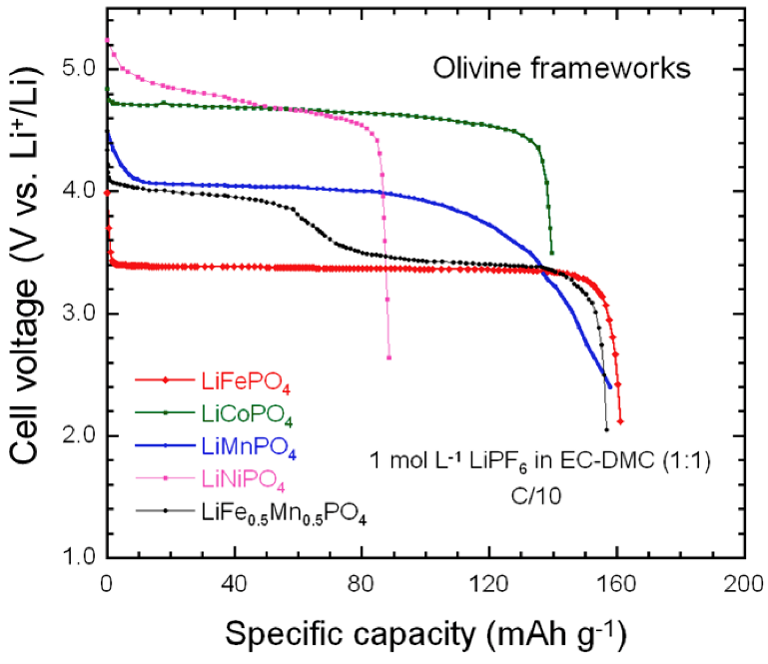
Batteries 2018, 4(3), 39; https://doi.org/10.3390/batteries4030039
You mentioned ALD coating of electrodes in the slides. Please comment on this technique.
Atomic Layer Deposition (ALD) is a common technique utilized within battery active material preparation. A typical process involves the deposition of a thin (1 to 2 nm) conformal layer of a ceramic material (e.g., Al2O3) onto the surface of cathode powders to prevent disadvantageous reactions with the electrolyte. This is particularly valuable for high Ni NMC cathodes (NMC811, NMC9055), whereby the presence of this protective layer can help to prevent oxygen loss at high states of delithiation (Cell Reports Physical Science, 2026; 7). The ALD technique is particularly suited to this due to its ability to form thin, defect-free, compositionally well-defined films. Excessively thick films will provide protection but will inhibit Li+ diffusion, limiting high-rate performance. The formation of such a protective layer is less critical for LMFP, though it may aid with preventing Mn dissolution [ACS Applied Materials & Interfaces 2019 11 (1), 957-962, DOI: 10.1021/acsami.8b18930].
Is humidity critical for LMFP cathode?
While LMFP itself is stable in the presence of moisture, it is nevertheless important to control humidity during slurry mixing and coating when utilizing an NMP solvent, as water will induce PVDF binder cross-linking and consequent slurry gelation. For small lab-scale processing this effect is minimal and is not typically a barrier. Of course, drying electrodes fully prior to electrolyte injection and cell assembly is critical regardless of cell chemistry.
What’s the failure mechanism of LMFP? How does it differ from LFP?
LMFP suffers from the same degradation modes as LFP (gradual SEI thickening with associated impedance increase and Li inventory loss), with two notable additions: Mn dissolution causes a higher rate of SEI thickening, while the voltage decay is unique to the Mn redox plateau.
What would be the distinct manufacturing challenges for blend cathodes, considering the different particle sizes of the NMC and LFP/LMFP particles?
This is a timely question, as CATL has just publicized some of their approach to manufacturing of blend cathodes (in this case, NMC and LFP). The blending of two active materials opens multiple new possibilities and degrees of freedom for optimization—so a big opportunity but work to do! Typically, small particle-phosphates require longer, more intensive mixing in order to effectively disperse agglomerates, while for larger-particle NMC, the process is more straightforward. Furthermore, phosphates typically take on relatively large quantities of surface-adsorbed water, which poses a problem when mixed with moisture sensitive high-Ni NMC, requiring more extreme drying steps.
Did you also observe Fe dissolution alongside Mn dissolution at higher voltage cutoffs?
Yes, we observed the presence of both Fe and Mn on the surface of anodes harvested from aged LMFP \\ Gr pouch cells post-mortem. Notably, the Mn concentration was highly dependent on the upper cutoff voltage (UCV) during cycling, whereby Fe concentration was not. This may be expected because all the Fe is oxidized to Fe3+ regardless of UCV, whereas the population of Mn3+ formed is dependent on UCV. Mn dissolution and subsequent “crosstalk” is thought to be particularly harmful due to a tendency to induce SEI thickening and thus loss of Li inventory [ACS Nano 2024 18 (13), 9389-9402, DOI: 10.1021/acsnano.3c10208].
In the bimodal system of NMC/LMFP, the operando XRD shows that the NMC suffers from serious aging, but there is almost no effect on LMFP. I would like to know the impact of this aging in NCM on this bimode/bimodal system in prolonged cycling. What is your opinion?
In the measurements I shared, we chose a cycling window (2.5 to 4.4 V) designed to particularly stress the NMC material, a “safer” window (3 to 4.2 V) would dramatically reduce NMC aging. Nevertheless, these materials would still possess varying degradation rates, complicating modelling and lifetime prediction. While blended anodes (Gr/Si) have been used in commercial batteries for many years with largely predictable behavior, these materials tend to lithiate sequentially (Si then Gr) under most conditions, which greatly simplifies degradation mode tracking via electrochemical methods. Developing a workable degradation model of the NMC/LMFP blend system (with concurrent lithiation) requires more advanced techniques such as in operando XRD.
Learn more about upcoming ECS Webinars and review previous webinar recordings.
Interested in presenting in the ECS Webinar Series? Email your presentation title and abstract to education@electrochem.org for consideration.