

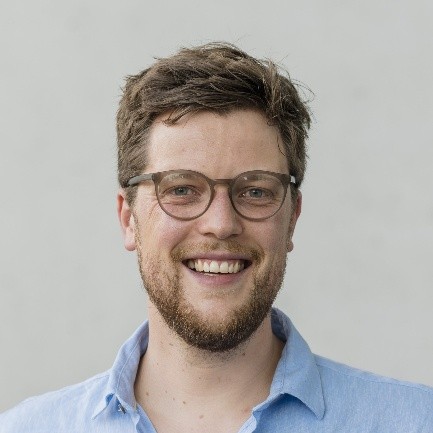
Lennart Reuter

Jonas Dickmanns
Presenters: Lennart Reuter, Uppsala universitet and Jonas L. S. Dickmanns, Technische Universität München
Date: August 5, 2026
Time: 1000–1100h ET
(Click to enlarge)
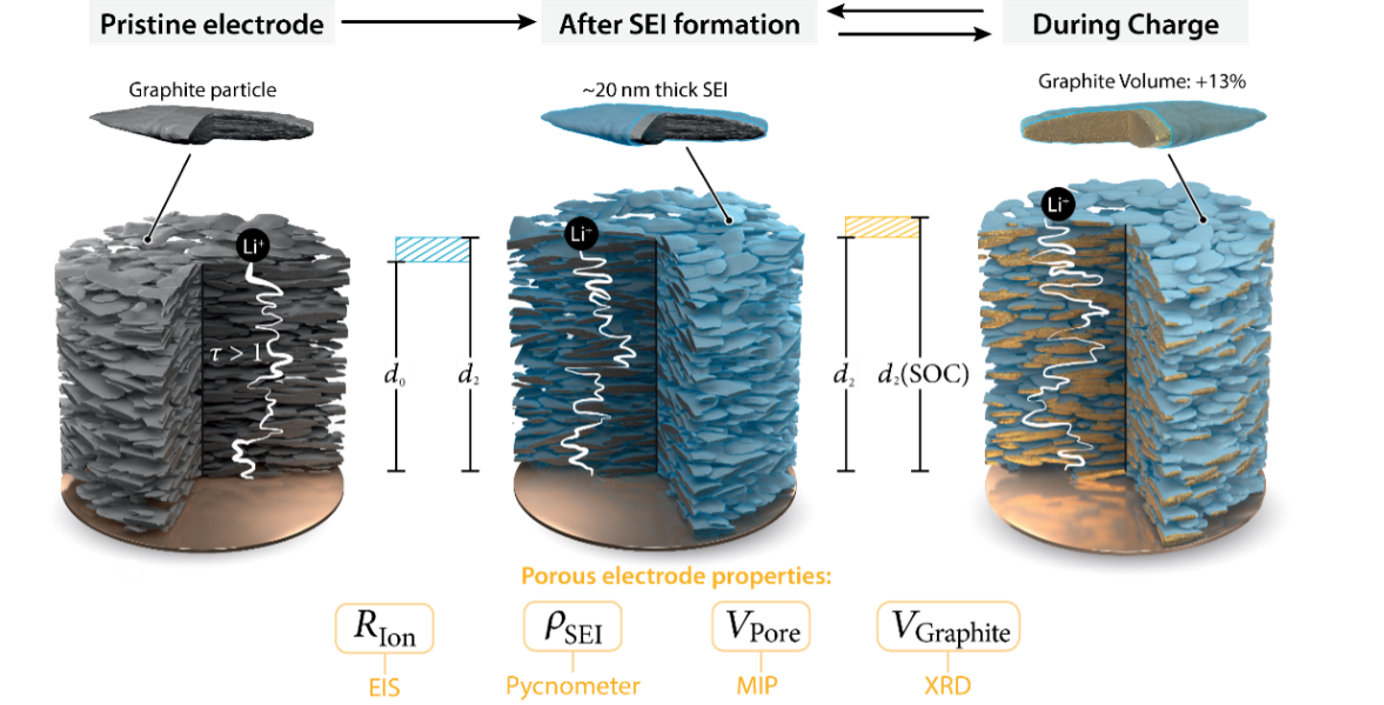
The fast-charging performance of lithium-ion batteries is strongly influenced by the structure of porous electrodes and its evolution during battery operation. In such electrodes, ionic transport is governed by the electrolyte conductivity as well as by the porosity, tortuosity, and thickness of the electrode. The latter parameters undergo both reversible and irreversible changes, induced by the lithiation and delithiation of graphite particles and by the formation of the solid-electrolyte interphase (SEI).
This webinar discusses how SEI formation alters electrode thickness, porosity, and tortuosity. Particular emphasis is placed on how these structural changes depend on the initial electrode porosity and how SEI formation can be quantitatively linked to the evolution of transport properties.
Second, it addresses state-of-charge–dependent effects. Graphite particle expansion during lithiation changes the pore structure, influencing electrode porosity, thickness, and pore volume. How these changes affect ionic resistance and electrolyte transport is shown, and how they connect to macroscopic effects such as the recently described electrolyte-motion-induced salt inhomogeneity (EMSI).
Together, these insights provide a coherent picture of how SEI formation and SOC-dependent expansion alter ionic transport in porous graphite anodes, offering guidance for electrode design and improved methodologies for realistic parameter determination used in battery modeling and fast-charging optimization.
Attend this webinar to learn about
-
How SEI formation alters porosity, tortuosity, and electrode thickness;
-
Understanding SOC-dependent graphite expansion and its impact on ion transport;
-
Quantitatively linking structural evolution to transport and modeling parameters.
Presenter
Lennart Reuter is a postdoctoral researcher at Uppsala universitet. He completed his PhD at the Technische Universität München (TUM) in 2025, under the supervision of Prof. Hubert Gasteiger. His research centers on identifying and quantifying material and electrolyte decomposition processes in lithium-ion batteries. He implemented OEMS for gas analysis in the presence of volatile commercial electrolytes and developed a novel three-electrode cell for the operando detection of parasitic side reactions. In addition, he investigated structural and transport changes in porous electrodes during operation, including the characterization of porous transport properties by electrochemical impedance spectroscopy (EIS). Dr. Reuter received the 2014 Royal Society of Chemistry’s Physical Chemistry Chemical Physics (PCCP) Hot Topic Prize for posters at the Bunsentagung.
Jonas L. S. Dickmanns is a PhD candidate supervised by Hubert Gasteiger at the Lehrstuhl für Technische Elektrochemie at the Technische Universität München (TUM), focusing on advanced lithium-ion battery cell chemistry and anode materials. He received his MSc in Chemistry from TUM, where he worked on the electrochemical characterization of graphite. He later expanded his research to other anode materials, including micro-scale silicon and silicon/carbon composites. His work investigates key electrode processes such as solid-electrolyte interphase (SEI) formation, structural evolution of anodes, and electrolyte interactions. The goal of his research is to enhance the performance, stability, and lifetime of next generation lithium-ion batteries.
Thank you to the sponsors who make these complimentary programs possible!
 |
 |
Interested in presenting in the ECS Webinar Series? Email your presentation title and abstract to education@electrochem.org for consideration.