

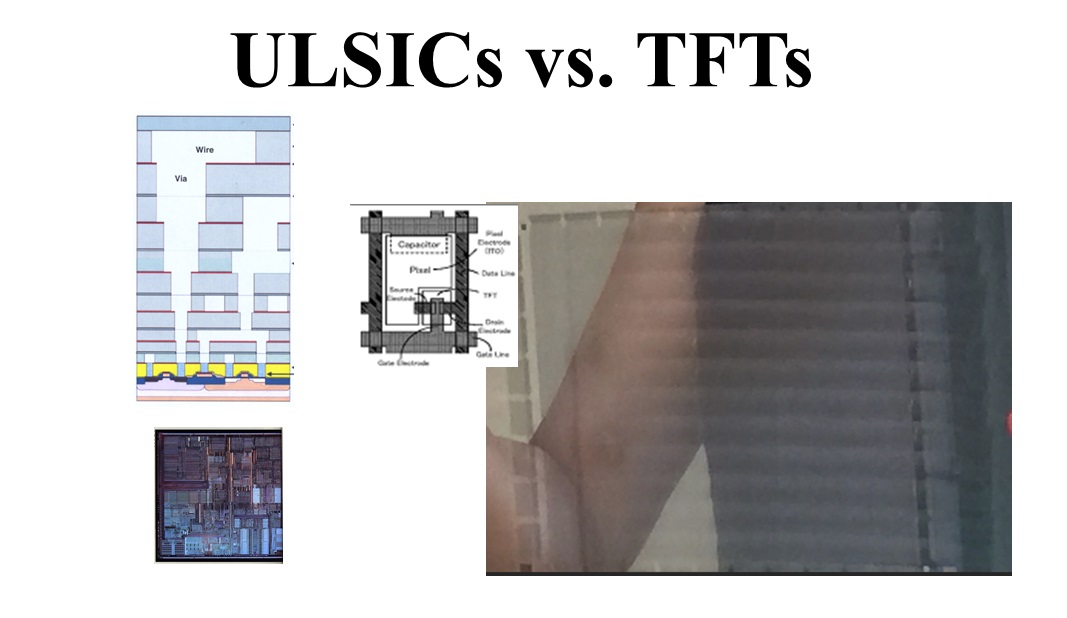
The ECS Journal of Solid State Science and Technology is publishing a collection of papers on ultra-large-scale integrated circuits vs thin-film transistors reflecting ECS biannual meetings symposia from 2007 to 2027.
Since the end of the 20th century, the two largest sectors of the microelectronics industry have been integrated circuits (ICs) and active-matrix flat-panel displays (AMFPDs). Their success has been driven by advances in semiconductor technology, including an improved understanding of field-effect transistor devices; the development of high-quality semiconductor, dielectric, and conductive materials; and the precise control of large-area, high-throughput fabrication processes. These industries also face many similar challenges, such as continuously improving device performance and reliability, introducing new materials, relentlessly reducing production costs, and expanding into novel applications.
This issue provides authors with an opportunity to publish new results in these two fields, not only in addressing current challenges but also in presenting their visions for future development trends.
The ECS Journal of Solid State Science and Technology invites researchers to submit articles to the Electronic Materials and Processing and Electronic and Photonic Devices and Systems topical interest areas of JSS.
Additional requirements
- Graphical abstracts are mandatory for submissions to JSS.
- ORCID iDs, which are required for all accepted papers, are included in article metadata. All authors listed on a manuscript submission, including the Submitting/Corresponding Author and all coauthors, must have valid accounts in the ECS ScholarOne Manuscripts submission system with linked, valid ORCID iDs.
- Corresponding authors of an article are the members of the author team who submit the original manuscript and submission form to the journal for consideration. These individuals are the primary points of contact for the journal, submit the articles on behalf of the entire author team, and confirm all certifying and attesting statements in the submission form. The corresponding authors are the single individuals responsible for all corresponding author duties. Corresponding authors cannot be changed once articles have been formally submitted.
Accepting submissions: December 8, 2026 | Submission deadline: April 8, 2027
Guest Editors
Yue Kuo, Texas A&M University, US; National Yang Ming Chiao Tung University, Taiwan, ROC | yuekuo@ymail.com
Andrew Flewitt, Cambridge University, UK | ajf23@cam.ac.uk
Technical Editors
Travis Anderson, University of Florida, US | tjanderson@che.ufl.edu
Tae-Yeon Seong, Korea University, South Korea | tyseong@korea.ac.kr
Editor-in-Chief
Fan Ren, University of Florida, US | ren@che.ufl.edu
Articles are published in a standard issue of the journal as they are accepted. If selected at submission, accepted papers are published online in the ECS Digital Library on IOPscience within 24 hours of scheduling for publication. The version of record is published online within approximately 10 days of final acceptance.
Visit the ECS website for author submission instructions and requirements for each article type.
OPEN ACCESS
To take advantage of an article credit, the submitting/corresponding author must be from an ECS Plus-affiliated institution or Institutional member or be an ECS member in good standing. The APC applied to an article is determined based on the year of publication, not the date of submission, revision, or acceptance.