
From televisions screens we can roll up like newspapers to see-through batteries, researchers are moving electronics toward a more flexible, more transparent future.

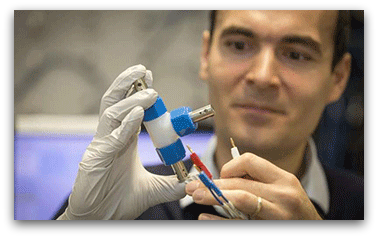
The most recent development in this area comes from a group that has developed transparent, flexible supercapacitors made of carbon nanotube films. But this development goes far beyond wearable electronics, with potential applications in both energy storage and harvesting.

“Potential applications can be roughly divided into two categories: high-aesthetic-value products, such as activity bands and smart clothes, and inherently transparent end-uses, such as displays and windows,” co-author of the study Tanja Kallio, told Phys.org. “The latter include, for example, such future applications as smart windows for automobiles and aerospace vehicles, self-powered rolled-up displays, self-powered wearable optoelectronics, and electronic skin.”

With the thin films demonstrating 92 percent transparency and high efficiency compared to other carbon-based counterparts, the researchers believe that further improvements to the supercapacitors durability and energy density could make the product commercially viable.
Floatovoltaics

Image: Kyocera

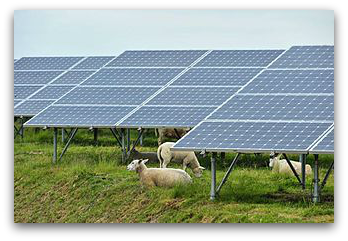
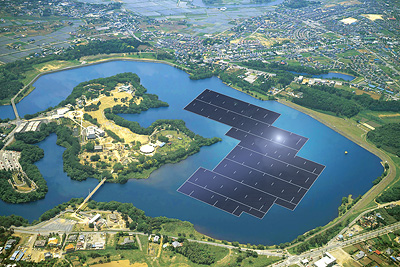
A joint venture between two Japanese companies has embarked on building the world’s largest floating solar project.

The project is estimated to harvest 16,170 megawatt hours per year – enough to power around 4,970 households.

Not only will the floating solar farm – which will consist of 50,904 panels – produce a large amount of renewable energy, it will also play a major role in offsetting over 8,000 tons of carbon dioxide emissions annually (the equivalent of 19,000 barrels of oil).

Japan is making the move to “floatovoltaics” due to the lack of open land suitable for solar farms, but plentiful water surfaces. Proponents believe floating solar farms will be cheaper to produce than their land counterparts due to less strict regulations held on water surfaces.

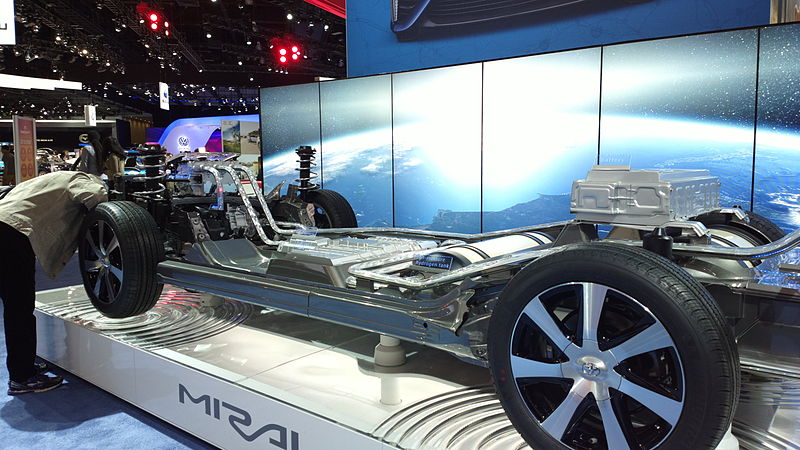
After Toyota’s 2015 release of the first mass-market fuel cell car, the Japanese automaker is gearing up to release the second generation of its fuel cell vehicle in 2019.

The initial version of the Mirai, which was heralded by Toyota as the ultimate “green car,” could travel up to 300 miles on a single tank of hydrogen and refuel in less than five minutes. The starting price for the vehicle is currently $57,460.

Toyota’s new version of the Mirai promises to be more affordable than its predecessor, potentially making the clean energy vehicle well-received among consumers.

(more…)

Science of Lightsabers

May the 4th be with you

Whether you’re a Star Wars superfan or find yourself lost when the conversation turns to discussions of the feasibility of the Death Star, you can probably identify the epic space series’ iconic lightsaber. The lightsaber has become one of the most recognizable images in popular culture, but is it purely fiction or could it be a reality?

According to the Star Wars books, lightsabers are pretty complex devices but essentially boil down to a few key elements: a power source and emitter to create light, a crystal to focus the light into a blade, a blade containment field, and a negatively charged fissure. In the Star Wars galaxy, a lightsaber creates energy, focuses it, and contains it.

But that’s fiction and those ideas are not in line with current science and technology. So how could we build a lightsaber with the tools we have today?

Many people look initially to laser technology when discussing a practical lightsaber. It’s unrealistic to say that light could be the source of the blade seeing as light has no mass (creating a pretty insufficient weapon), but lasers could be an alternative. It may seem contradictory to say that lasers could be the blade in a lightsaber when lasers are essentially light focused to a very fine point, but as Looper puts it, light is to a laser what a tree is to paper.

(more…)

Wasted Food is Wasted Energy

When we discuss energy, we usually talk about how to harness it or how to store it. But what about conserving the energy we’re wasting every day?

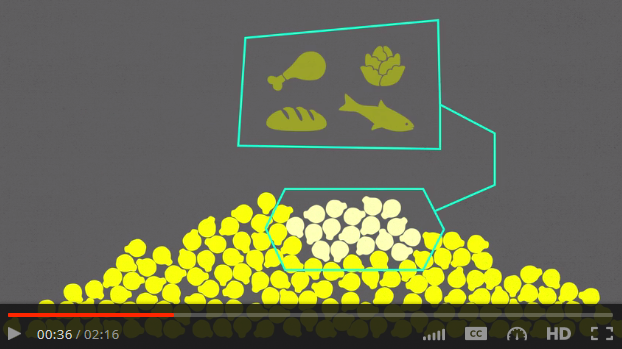
A recent study out of the University of Texas uncovered just how much energy we’re wasting through the excessive waste of food. For every four meals that make their way to our plates, an equivalent of one to two is discarded. When examining the energy used to grow, irrigate, fertilize, and transport that food — the amount of energy wasted begins to add up. Watch the video.

food-video

Antalexion

Image: Antalexion

With the increasing popularity of solar power and ongoing dialogue about the effects of climate changes comes inevitable discussions about the viability of renewable energy. While efficiency levels have grown tremendously over the years, many still worry about the feasibility of solar panels during inclement weather when the sun is not shining its brightest.

To address that issue, more attention has been focused on energy storage. However, a group of Chinese scientists are turning to the solar panels themselves to answer some of these questions.

In a recently published paper, scientist detailed a new way for solar panels to produce electricity from rain water. The way it works is pretty simple: researchers apply a thin layer of graphene to the bottom of the solar panel; when it rains, you simply flip the panel and allow the positively charged ions from the rain drops to interact with the graphene and produce electricity.

“Although great achievements have been made since the discovery of various solar cells, there is still a remaining problem that the currently known solar cells can only be excited by sunlight on sunny days,” wrote the researchers in the paper.

(more…)

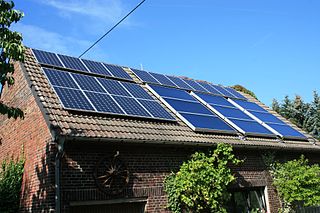
Rooftops can provide more than shelter from the elements; they may also provide a goldmine of untapped energy production.

The U.S. Department of Energy’s National Renewable Energy Laboratory (NREL) recently issued a report stating that rooftop solar panels have the potential to power nearly 40 percent of the U.S.

“It is important to note that this report only estimates the potential from existing, suitable rooftops, and does not consider the immense potential of ground-mounted PV,” co-author of the report Robert Margolis said. “Actual generation from PV in urban areas could exceed these estimates by installing systems on less suitable roof space, by mounting PV on canopies over open spaces such as parking lots, or by integrating PV into building facades. Further, the results are sensitive to assumptions about module performance, which are expected to continue to improve over time.”

Essentially, solar panels could have limitless possibles. However, land is a precious commodity. Roofs, however, provide a space that typically goes unused to generate a huge amount of power for the U.S.

PV Hybrid

A research team aims to make a battery and solar cell hybrid out of two single systems.
Image: Lunghammer – TU Graz

People across the globe are looking toward renewable solutions to change the landscape of energy. But what happens when the sun goes down and the wind stops blowing? In order to guarantee green energy that is consistent, reliable energy storage systems are critical.

“Currently, single systems of photovoltaic cells which are connected together — mostly lead-based batteries and vast amounts of cable — are in use,” said Ilie Hanzu, TU Graz professor and past member of ECS. “We want to make a battery and solar cell hybrid out of two single systems which is not only able to convert electrical energy, but also store it.”

The idea of a battery and solar cell hybrid is completely novel scientific territory. With this project, entitled SolaBat, the team hopes to develop a product that has commercial applications. For this, the scientists will have to develop the perfect combination of functional materials.

“In the hybrid system, high-performance materials share their tasks in the solar cell and in the battery,” Hanzu said. “We need materials that reliably fulfill their respective tasks and that are also electrochemically compatible with other materials so that they work together in one device.”

(more…)

When we think of carbon and the environment, our minds often develop a negative association between the two in light of things such as greenhouse gases and climate change. But what if carbon is the answer to clean energy?

A team of researchers at Griffith University is looking toward carbon to lead the way in the clean energy revolution. Their latest research showed that carbon could be used to produce hydrogen from water. This could offer a potential replacement for the costly platinum materials currently used.

“Hydrogen production through an electrochemical process is at the heart of key renewable energy technologies including water splitting and hydrogen fuel cells,” says Professor Xiangdong Yao, leader of the research group. “We have now developed this carbon-based catalyst, which only contains a very small amount of nickel and can completely replace the platinum for efficient and cost-effective hydrogen production from water.”

(MORE: Learn about the future of electrochemical energy.)

This from Griffith University:

Proponents of a hydrogen economy advocate hydrogen as a potential fuel for motive power including cars and boats and on-board auxiliary power, stationary power generation (e.g., for the energy needs of buildings), and as an energy storage medium (e.g., for interconversion from excess electric power generated off-peak).

Read the full article.

The researchers also believe that these findings could open the door for new development in large-scale water electrolysis.

MIT researcher have developed the first steps to creating the thinnest, lightest solar cell ever made.

Through a unique fabrication method, the researchers are moving toward the development of a solar cell so thin it could blow away. Instead of a solar cell’s typical makeup, the MIT researchers have opted for a unique fabrication of creating each layer at the same time.

This from Popular Science:

Solar cells are typically made up of layers of photovoltaic materials and a substrate, such as glass or plastic. Instead of the usual method of fabricating each layer separately, and then depositing the layers onto the substrate, the MIT researchers made all three parts of their solar cell (the cell, the supportive substrate, and the protective coating) at the same time, a method that cuts down on performance-harming contaminants. In the demonstration, the substrate and coating are made from parylene, which is a flexible polymer, and the component that absorbs light was made from dibutyl phthalate (DBP). The researchers note that the solar cell could be made from a number of material combinations, including perovskite, and it could be added to a variety of surfaces such as fabric or paper.

Read the full article.

To put the thinness of the solar cell in perspective, it is approximately 1/50th the thickness of a strand of hair. The light weight means that its power-to-weight ratio is particularly high, with an efficiency output of about 6 watts per gram (400 times higher than silicon-based solar cells).

The final trial for the researcher will be to translate the lab work to the real world, making it scalable and practical for commercial use.

ECS
Privacy Overview

This website uses cookies so that we can provide you with the best user experience possible. Cookie information is stored in your browser and performs functions such as recognising you when you return to our website and helping our team to understand which sections of the website you find most interesting and useful.