New Sensor Can Improve the Taste of Your Wine

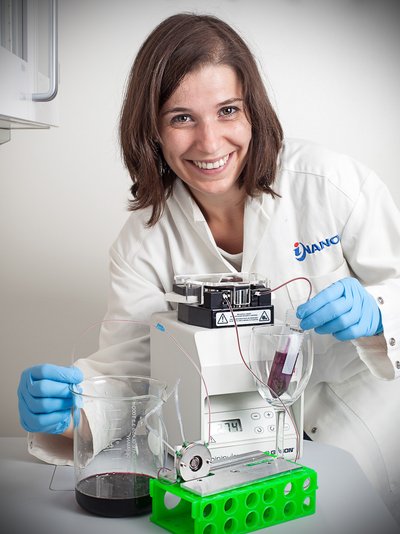
PhD student Joana Guerreiro has taken part in developing a sensor, which has been dubbed the 'mini-mouth'.Credit: Lars Kruse, Aarhus University

PhD student Joana Guerreiro has taken part in developing a sensor, which has been dubbed the ‘mini-mouth’.
Credit: Lars Kruse, Aarhus University

The ‘mini-mouth’ – that’s what scientists have dubbed the new nanosensor that can mimic the sensation that wine creates in a person’s mouth, which then determines how a specific alcohol tastes.

This technology was created by PhD student Joana Guerreiro from Aarhus University in Denmark, and sets out to detect the level of astringency associated with a particular wine. A wine’s astringency is characterized by the dry sensation drinkers get in their mouth when they drink wine.

This from Aarhus University:

Quite specifically, the sensor is a small plate coated with nanoscale gold particles. On this plate, the researchers simulate what happens in your mouth by first adding some of the proteins contained in your saliva. After this they add the wine. The gold particles on the plate act as nano-optics and make it possible to focus a beam of light below the diffraction limit so as to precisely measure something that is very small – right down to 20 nanometres. This makes it possible to study and follow the proteins, and to see what effect the wine has. It is thereby possible to see the extent to which the small molecules have to bind together for the clumping effect on the protein to be set off.

Read the full article here.

While the technique itself is not new, the ingenuity lies in using it to create a sensor that can measure an effect rather than just the number of molecules.

This technology seems as though it would threaten the livelihood of sommeliers, but researchers say that is not what the sensor is intended for. Instead, the team at Aarhus University hopes that this will produce a tool that is useful in wine production.

Want to see what else sensors can do? Head over to our Digital Library to see the newest cutting-edge sensor research.
23 Reasons You Should be in Cancun

Watch the video and hear at least 23 reasons for coming to the meeting! (Yes, I counted.)

Register now for the 2014 ECS and SMEQ (Sociedad Mexicana de Electroquímica) Joint International Meeting to be held October 5-9, 2014.

This major international conference offers a unique blend of electrochemical and solid-state science and technology; and serves as a major forum for the discussion of interdisciplinary research from around the world through a variety of formats, such as oral presentations (51 symposia and 2,299 papers being presented), poster sessions, exhibits, and tutorial sessions.

ECS is partnering with the Bill & Melinda Gates Foundation to host a multi-day workshop at the 2014 International Electrochemical Energy Summit (E2S) which takes place during the meeting. The workshop will culminate in the distribution of over $200,000 in seed funding from ECS, addressing critical technology gaps in water, sanitation, and hygiene challenges being faced around the world.

Find out more and register online now.

It’s at the beautiful, all-inclusive Moon Palace Resort Hotel, located on the best beach in Cancun and just minutes from the Cancun Airport.

Daily room rates include all of the following:

  • Unlimited meals, snacks, and beverages (including all alcoholic beverages), in twelve onsite restaurants featuring varied cuisine, including Italian, Asian, Mexican, Brazilian, and Continental;
  • Mini bar in room;
  • All gratuities (restaurants, lounges, poolside, bellmen, and housekeeping) and hospitality tax;
  • Water-sport facilities with non-motorized equipment such as sailboats, kayaks, and paddle boats at Moon Palace Marina;
  • Complimentary tennis, bicycling, miniature golf, and use of the health club;
  • Jacuzzi in every room; and
  • Wireless Internet access from your laptop!

Sign up now!

Posted in Uncategorized

A Light Show on Four Wheels

Because it does not require heat to produce light, EL is safe, efficient, and long lasting.Credit: Darkside Scientific

Because it does not require heat to produce light, EL is safe, efficient, and long lasting.
Credit: Darkside Scientific

Imagine being able to paint light on an object. With Darkside Scientific’s patented technology known as LumiLor, the company is now able to turn light into paint.

Recently, the company released a video of a car treated with LumiLor, which showcases the patented technology in all its luminescent glory.

The process is made possible through electroluminescent (EL) coating technologies, which is a characteristic of material that enables it to emit light in response to an electrical field.

The from Darkside Scientific:

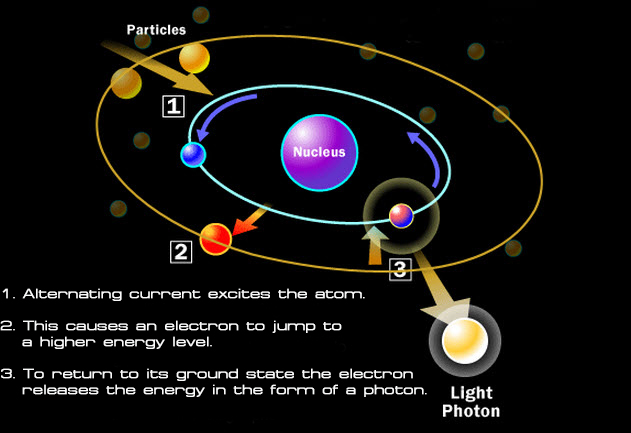
At the sub-atomic level, the process behind electroluminescence is radiative recombination, also known as spontaneous emission. In radiative recombination, phosphorescent substances emit photons (light particles) in response to alternating electrical current.

Read the full article here.

For more information on electroluminescent technologies, check out the wealth of information on the topic in ECS’s Digital Library.

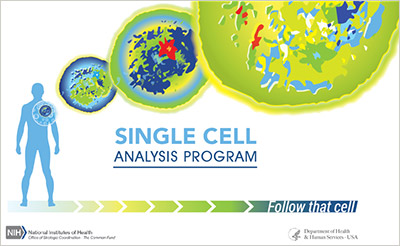
The National Institutes of Health is challenging science innovators to compete for prizes totaling up to $500,000, by developing new ways to track the health status of a single cell in complex tissue over time.

The National Institutes of Health is challenging science innovators to compete for prizes totaling up to $500,000, by developing new ways to track the health status of a single cell in complex tissue over time.

The National Institutes of Health (NIH) recently announced an exciting new challenge through the InnoCentive Platform that will award a total of $500,000 to creative minds that are interested in solving some of the world’s most important problems.

The Single Cell Analysis Program (SCAP) Challenge is aimed to spur the development of innovative solutions in single cell analysis. Through advances in cellular analysis, NIH hopes to develop tools that would monitor a cell in the process of becoming cancerous, detect changes due to disease-causing virus, or track how a cell responds to treatment.

The challenge’s goal is to generate creative ideas and methods for following and predicting a single cell’s behavior – in essence, allowing one to “Follow that Cell.”

This from the National Institutes of Health:

Many biological experiments are performed under the assumption that all cells of a particular “type” are identical. However, recent data suggest that individual cells within a single population may differ quite significantly and these differences can drive the health and function of the entire cell population. Single cell analysis comprises a broad field that covers advanced optical, electrochemical, mass spectrometry instrumentation, and sensor technology, as well as separation and sequencing techniques.

(more…)

First Graphene-Based Flexible Display Produced

"This is a significant step forward to enable fully wearable and flexible devices ." -Andrea Ferrari, Director of the Cambridge Graphene Centre

“This is a significant step forward to enable fully wearable and flexible devices .”
-Andrea Ferrari, Director of the Cambridge Graphene Centre

There has been quite the buzz around graphene lately. With this material being among the strongest and most lightweight known, it has the potential to revolutionize industries from healthcare to electronics. And revolutionize is exactly what the Cambridge Graphene Centre (CGC) and Plastic Logic have set out to do.

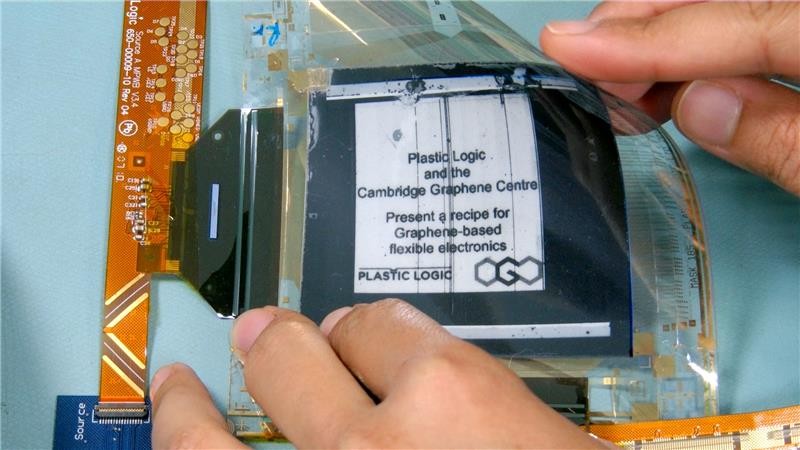
With the CGC’s graphene expertise and Plastic Logic’s already developed technology for flexible electronics, the two came together to demonstrate the first graphene-based flexible display.

This from University of Cambridge:

The new prototype is an active matrix electrophoretic display, similar to the screens used in today’s e-readers, except it is made of flexible plastic instead of glass. In contrast to conventional displays, the pixel electronics, or backplane, of this display includes a solution-processed graphene electrode, which replaces the sputtered metal electrode layer within Plastic Logic’s conventional devices, bringing product and process benefits.

(more…)

The researchers discovered that two flat semiconductor materials can be connected edge-to-edge with crystalline perfection.Credit: University of Washington

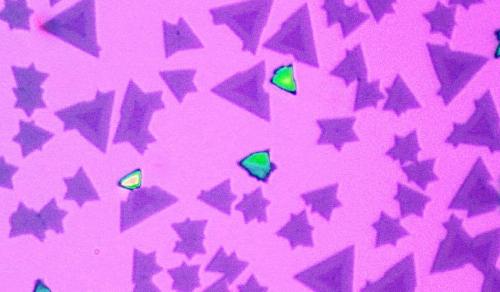
The researchers discovered that two flat semiconductor materials can be connected edge-to-edge with crystalline perfection.
Credit: University of Washington

Current member of ECS, Xiaodong Xu, has made a huge contribution to the field of electrochemical science with the creation of atomically seamless, thinnest-possible semiconductor junctions.

Xu, along with the scientists at the University of Washington, believe their semiconductor – coming in at only three atoms thick – is the most slender possible, a new class of nanoscale materials.

This from the University of Washington:

The University of Washington researchers have demonstrated that two of these single-layer semiconductor materials can be connected in an atomically seamless fashion known as a heterojunction. This result could be the basis for next-generation flexible and transparent computing, better light-emitting diodes, or LEDs, and solar technologies.

Read the full article here.

“Our experimental demonstration of such junctions between two-dimensional materials should enable new kinds of transistors, LEDs, nanolasers, and solar cells to be developed for highly integrated electronic and optical circuits within a single atomic plane,” Xu said.

The research was published online this week in Nature Materials.

Find more research from Xu published in our Digital Library.

4 Useful Electrochemistry Websites

Websites of Note

Websites of Note are gathered by Zoltan Nagy.

This is the latest Websites of Note, a regular feature in the ECS magazine Interface researched by Zoltan Nagy, a semi-retired electrochemist.

Lecture Notes in Electrochemistry/Electrochemical Engineering – M. Bazant, MIT
Detailed course material from MIT, including: equivalent circuit models, thermodynamics, reaction kinetics, transport phenomena, electrostatics, electrokinetics, porous media, and phase transformations.

Electroforming — a Unique Metal Fabrication Process – R. Parkinson, Nickel Development Institute
Electroforming plays an important role in our daily lives. We have contact with its results many times each day and it greatly enhances our lifestyle in a variety of ways. In addition, it is an extremely versatile process. For instance, it is used to produce micro components for the medical and electronics industries and huge components for the aircraft and aerospace industries. For many applications it has become indispensable.

Electrochemical Machining of Metal Plates – J.F. Cooper and M.C. Evans, Lawrence Livermore National Laboratory
Technical basis of electrochemical machining. Experimental basis of electrochemical machining. Theoretical basis of current distribution. Experimental tests and results (stationary cathode, advancing cathode, rotating cathode). Interpretations of results. Implementation of the process.

Electropolishing of Stainless Steels – Kosmač, Euro Inox
Electropolishing is a chemical surface finishing technique, by which metal is electrolytically removed, ion by ion, from the surface of a metal object. The primary objective is to minimize microroughness, thus dramatically reducing the risk of dirt or product residues adhering and improving the cleanability of surfaces. Electropolishing is also used for deburring, brightening, and passivating. The process exposes an undisturbed, metallurgically clean surface, eliminating thermal stress and surface roughening, and improving the corrosion resistance.

Dr. Nagy welcomes suggestions for entries; send them to nagyz@email.unc.edu.

GM Cars Will Soon Know When You’re Distracted

Thanks in large part to scientific breakthroughs in sensors, cars have been getting smarter – and soon they’ll be able to tell if you’re distracted behind the wheel.

General Motors and Australian company Seeing Machines have landed a 15 year deal to create sensors that will detect when drivers are distracted.

Read the full article here.

This from the company news release:

The Seeing Machines’ Operator Monitoring System is based on patented eye-tracking technology that uses sensing equipment that requires no re-calibration between different drivers and tracks head alignment for potential distraction of the driver.

The sensors are another addition to the technology that could assist in the creation of the fully driverless car. With the United Services Auto Association noting that auto-breaks, collision assurance, and adaptive cruise control potentially coming to a car dealership near you, it is apparent that our cars are getting smarter.

Though we may be several decades away from these fully driverless cars, the sensor technology in automobiles is assisting in driver safety through anti-distraction technology.

“Eye and head tracking technology is the next step in automotive safety, which we expect to play a significant role in the reduction of one of the greatest causes of accidents: driver distraction,” said Ken Kroeger, CEO of Seeing Machines. “We strongly believe that the addition of driver monitoring to ADAS will deliver a significant improvement to the safety of drivers, passengers and pedestrians.”

Learn more sensor science and technology and their global impact via ECS’s Digital Library.

Google Science?

Google scholar logo

“Google Science” would launch a number of journals, be “self-organising” and yet have a team of “qualified reviewers.”

There is a Google Scholar, but what if there was a Google Science? The UK edition of Wired magazine is tracking the mystery of whether it is or is not in the mix in How ‘Google Science’ could transform academic publishing.

“Google Science” would launch a number of journals, be “self-organising” and yet have a team of “qualified reviewers”.

“99.9 percent of the work, including peer review would be done by the scientific community,”

This is, of course, about open access an issue we at ECS are committed to. There’s a great discussion on this. The article says:

“Most [academics] don’t particularly care about open access, in part because they are not incentivised to do so. This is changing, but only slowly, and right now most still care more about publishing in established, high-profile journals and in gaining a lot of citations.”

Google could change the game, if they really were going to get involved. Spoiler alert: Wired found no evidence a Google Science was in the works.

Find out more about ECS open access.

Deepak Chopra

Chopra wants to know how one can physically detect the content of a thought. If you know, you could win $1 million. Source: YouTube

Want to win $1 million? Well now you can – as long as you can give a valid scientific explanation for the biological basis of a first-person experience, that is.

Deepak Chopra has posted a video on YouTube asking viewers to offer a scientific understanding for the biological basis of an idea.

This from Chopra:

Just tell me how does electrochemistry produce a thought, an idea, and you get the million dollars. I will live up to this. But it has to be a valid, scientific explanation for the biological basis of an idea.

Watch the video below.

Before taking your shot at winning $1 million, read up on some of the latest research in electrochemical by the best scientists in the field.

ECS
Privacy Overview

This website uses cookies so that we can provide you with the best user experience possible. Cookie information is stored in your browser and performs functions such as recognising you when you return to our website and helping our team to understand which sections of the website you find most interesting and useful.