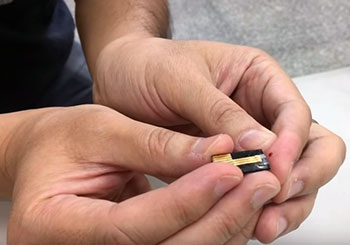
The portable biosensor can test specific cardiac markers in five minutes with a single drop of blood.
Credit: Yu-Lin Wang
A team of researchers from National Tsing Hua University and National Cheng Kung University, both in Taiwan, has developed a low-cost, portable medical sensor package that has the potential to alert users of medical issues ranging from severe heart conditions to cancer, according to a new study published in the ECS Journal of Solid State Science and Technology.
Portable medical devices have become an integral part of holistic health care, exhibiting huge potential in monitoring, medical therapeutics, diagnosis, and fitness and wellness. When paired with benchtop point-of-care instruments used in hospitals and urgent care centers, individuals are able to both increase preventative care measures and gain a more complete picture of their health.
According to the open access paper, “Field-Effect Transistor-Based Biosensors and a Portable Device for Personal Healthcare” (ECS J. Solid State Sci. Technol., 6, Q71 [2017]), researchers have reported the design, development, fabrication, and prototyping of a low-cost transistor-based device that can measure the C-reactive protein (CRP) in bloodstreams, which, when elevated, indicates inflammation that could be linked to heart attack, stroke, coronary artery disease, and a host of other medical diagnosis.
(more…)


 The ECS Sensor Division election is now open and features an excellent slate of candidates. This year’s ballot includes two candidates for the volunteer position of division treasurer. Both would bring valuable experience and perspectives to the position. Their biographies and candidate statements follow.



 Deadline Extended: March 19, 2018
 Engineers used tissue paper—similar to toilet tissue—to make a new kind of wearable sensor that can detect a pulse or a blink of an eye.