
In an era where energy storage defines the pace of technological progress, breakthroughs in battery science are not just academic; they are transformative. A compelling new article by Jan Haß, Jonas Görtz, Janik Hense, and Andreas Jupke, published on IOPscience, offers deep insights into cutting-edge developments shaping the next generation of electrochemical systems.

A pivotal challenge in battery technology

Reaction Protocol for the Electro-Oxidation of Ethylene Glycol on Gold in PET Upcycling,” featured research  in the Journal of The Electrochemical Society (JES)—one of the most respected journals in the field—addresses a pivotal challenge in battery technology. The work explores advanced materials and mechanisms that could significantly enhance how energy is stored and delivered in lithium-based systems. While lithium ion batteries already power everything from smartphones to electric vehicles, scientists are constantly pushing boundaries to improve efficiency, durability, and safety—goals that are crucial for sustainable energy solutions and broader electrification efforts. (more…)
All-solid-state batteries are widely viewed as a next-generation solution for safer and higher energy storage. But translating promising materials from the lab to large-scale manufacturing depends on more than performance alone—it also requires compatibility with real-world production environments.

A new open-access article in the Journal of The Electrochemical Society examines how chloride-based solid-state electrolytes behave when exposed to dry room conditions commonly used in battery manufacturing. The study focuses on practical considerations that matter for scalability, offering valuable insight into how these materials respond outside ideal laboratory settings.  (more…)

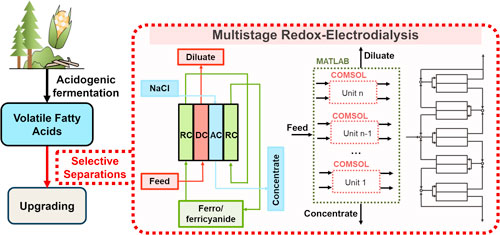
Volatile fatty acids (VFAs) from biomass fermentation offer a sustainable alternative to petroleum-based chemicals, serving as building blocks for bioplastics, pharmaceuticals, and more. However, separating and purifying these acids from fermentation broths remains technically challenging.

A new study in the Journal of The Electrochemical Society, selected as an Editors’ Choice article, addresses this bottleneck. Researchers Riccardo Candeago, Nidhish Lella, Wangsuk Oh, Ping Liu, and Xiao Su developed a physics-based model of redox-mediated (more…)

The Electrochemical Society (ECS) seeks nominations for the position of Technical Editor for the Sensors topical interest area within the Journal of The Electrochemical Society (JES).

The Technical Editor plays a critical leadership role in maintaining JES’s reputation for publishing high-quality, peer-reviewed research that advances the frontiers of electrochemical science and technology. (more…)

Nomination deadline: March 15, 2026

The Journal of The Electrochemical Society (JES) invites nominations for the position of Technical Editor in the topical interest area (TIA) of Battery and Energy Storage.

On December 31, 2026, Dr. Doran Aurbach completes his 12-year term as Technical Editor for this important topic area. Under his leadership, the Battery and Energy Storage TIA has become the most active in JES—garnering the highest number of citations, submissions, and associate editors in the journals portfolio.

Recognizing the critical importance of this TIA to JES and the global electrochemical science community, the ECS Publications Subcommittee seeks a highly qualified and visionary individual to continue this legacy of excellence.

(more…)

The Journal of The Electrochemical Society (JES) proudly celebrates the rapid success of the open access article “Understanding Lithium Deposition in Lithium-Ion Batteries: The Link between Impedance Results and Electrochemical Behavior.” In just a few short weeks since publication, this paper has risen to the top of JES’s Most Read Articles of 2025, capturing global attention for its clarity, rigor, and real-world relevance.

Illuminating Lithium Deposition

Lithium deposition, or plating, remains a major challenge in advancing lithium-ion batteries. When metallic lithium forms during fast charging or under non-ideal conditions, it can cause dendrites, capacity loss, and safety risks. This groundbreaking study offers fresh insight by directly linking impedance spectroscopy results to electrochemical deposition behavior, providing researchers with a predictive framework to better understand and control plating phenomena.

By connecting impedance signals with changes in morphology and capacity, the authors reveal when and how lithium deposition occurs. Their work identifies spectral features associated with plating onset, evolving interfacial kinetics, and irreversible capacity fade—insights that will guide the design of safer and more durable energy storage systems. (more…)

The Electrochemical Society (ECS) seeks nominations for the position of Associate Editor for the Journal of The Electrochemical Society (JES) in the electrochemical sensors topical interest area.

Nominees for this editorial position possess and maintain authoritative scientific knowledge in the field of electrochemical sensors as outlined in the ECS topical interest areas.

The Associate Editor works in support of the Technical Editor and Editor-in-Chief of JES to ensure rigorous peer review and uphold the quality and reputation of the journal.

Appointment details

(more…)

Spotlight on Maria Kelly, Rachel A. Wnuk, Recep Kaş, Glenn Teeter, Melissa E. Kreider, and Wilson A. Smith for their Editor’s Choice article published in the Journal of The Electrochemical Society (JES) titled “Rapid Deactivation Convolutes Electrochemical CO2 Reduction Selectivity Measurements on Gold Rotating Ring Disk Electrodes.” The corresponding author of this work is Maria Kelly, an ECS Student member at University of Colorado Boulder, affiliated with the ECS Physical and Analytical Electrochemistry Division. Maria works in the lab of  Wilson T. Smith, Principal Investigator of UC Boulder’s Electrobuffs Team.

Read now

(more…)

We are delighted to announce that 10 articles published in the Journal of The Electrochemical Society (JES) have been honored with the Institute of Physics Publishing’s (IOPP) North American Top Cited Paper Awards for 2024. These awards recognize the top one percent of the most-cited articles published in IOP journals over the past year, highlighting the significant impact and quality of research contributed by our authors.

We extend our heartfelt congratulations to the authors of the following distinguished papers: (more…)

The Journal of The Electrochemical Society (JES) welcomes nominations for the role of Technical Editor in the topical interest area of Physical and Analytical Electrochemistry, Electrocatalysis, and Photoelectrochemistry (PAE). This vital editorial role is integral to maintaining the journal’s high standards of scientific excellence and ensuring the success of its publication efforts.

Scope of the role

The nominee should possess demonstrated expertise and scientific knowledge within the scope of Physical and Analytical Electrochemistry, Electrocatalysis, and Photoelectrochemistry. Specific areas of interest include, but are not limited to: (more…)

  • Page 1 of 12
ECS
Privacy Overview

This website uses cookies so that we can provide you with the best user experience possible. Cookie information is stored in your browser and performs functions such as recognising you when you return to our website and helping our team to understand which sections of the website you find most interesting and useful.