


Prof. Nagappan Ramaswamy
Prof. Nagappan Ramaswamy
Indian Institute of Technology Bombay
Date: February 18, 2026
Time: 1000-1100h ET
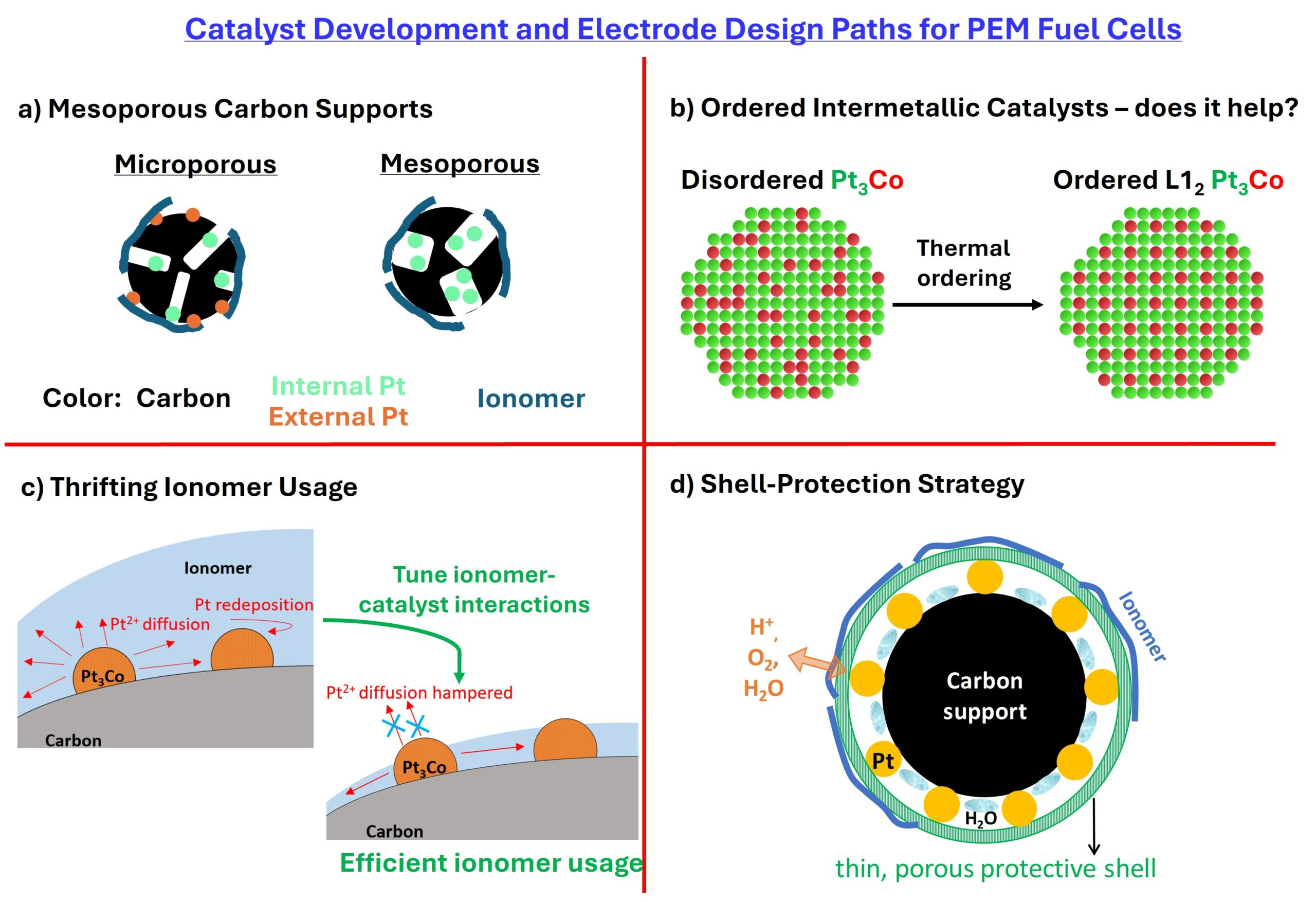
Heavy-Duty Vehicles (HDV) powered by hydrogen-based Proton Exchange Membrane (PEM) fuel cells offer a cleaner alternative to the diesel-powered internal combustions engine vehicles for decarbonization of long-haul transportation sectors. The development path of sub-components for HDV fuel cell applications is guided by the Total Cost of Ownership (TCO) analysis of the truck. TCO analysis suggests that the cost of the hydrogen fuel consumed over the lifetime of the HDV is more dominant due to the operation of the trucks for longer mileage (~a million miles) than the fuel cell stack Capital Expense (CapEx). Commercial HDV applications consume more H2 fuel and demand higher durability and hence the TCO of the vehicle is largely related to the fuel cell efficiency and durability of catalysts. This article is written to bridge the gap between the industrial requirements and academic activity for advanced cathode catalysts with an emphasis on durability. From a materials perspective, the underlying nature of the carbon support, Pt-alloy crystal structure, stability of the alloying element, cathode ionomer volume fraction, and catalyst-ionomer interface play a critical role in improving performance and durability. We provide our perspective on four major approaches, namely, mesoporous carbon supports, ordered PtCo intermetallic alloys, thrifting ionomer volume fraction, and shell-protection strategies that are currently being pursued. While each approach has its merits and demerits, their key developmental needs for the future are highlighted.
(Click to enlarge)
Learn:
- A better understanding of the realities of catalyst development from an industrial perspective;
- A guided approach for catalyst development in academia;
- Requirements and targets for catalyst development.
Presenter
Nagappan Ramaswamy is Associate Professor at the Indian Institute of Technology Bombay(IIT). His primary research interests include various low temperature electrochemical energy conversion and storage devices such as fuel cells, electrolyzers and redox flow batteries involving materials development, stack design and diagnostics. He received his PhD in 2011 from Northeastern University in the field of fuel cell electrocatalysis. He then spent 13 years working in industrial R&D, including two years at Nissan North American working on lithium-ion batteries, followed 11 years at General Motors (GM) working in the fields of low-temperature fuel cells and electrolyzer technologies. While at GM, he led two multi-million-dollar research projects funded by the US Department of Energy focused on the development of proton exchange membrane fuel cells for automotive applications. He joined the Department of Chemical Engineering faculty at IIT in January 2025.
Interested in presenting in the ECS Webinar Series? Email your presentation title and abstract to education@electrochem.org for consideration.