

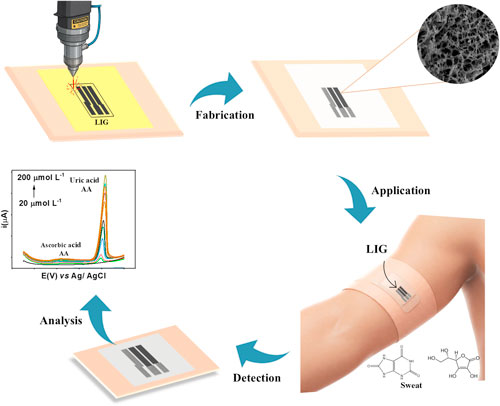
(Click to enlarge)
In their recent ECS Sensors Plus article, authors Leyllanne K. A. Souza, Maxwell D. Bridges, Thaisa A. Baldo, Wendell K. T. Coltro, and Charles S. Henry introduce an innovative and accessible approach to wearable biosensing by transforming a simple adhesive bandage into a high-performance electrochemical sensor.
Delivering low-cost, non-invasive, real-time health monitoring
As demand grows for non-invasive, real-time health monitoring, sweat has emerged as a valuable biofluid for tracking physiological biomarkers. In this study, researchers developed a flexible sensing platform using laser-induced graphene (LIG), a porous, conductive material created through laser processing, and transferred it onto a commercial adhesive bandage. The result is a lightweight, skin-conformal sensor capable of detecting key metabolites directly from sweat.
The device simultaneously measures uric acid (UA) and ascorbic acid (AA) using differential pulse voltammetry, demonstrating strong sensitivity, reproducibility, and selectivity within physiologically relevant ranges. Notably, the sensor maintains reliable performance in artificial sweat while remaining low cost and simple to fabricate—an important consideration for scalable wearable technologies.
By integrating advanced carbon materials with everyday medical supplies, this work highlights a practical pathway toward affordable, disposable wearable sensors for health monitoring, athletic performance tracking, and point-of-care diagnostics.
Showcasing sensor science and technology
This research underscores the growing impact of electrochemical innovation in wearable systems and reinforces the mission of ECS Sensors Plus to showcase forward-looking developments in sensor science and technology.