
A debate held at the annual Charleston Library Conference tackles the journal impact factor, with speakers looking at the metric and analyzing if it does more harm than good. The debate was moderated by Rick Anderson, Associate Dean for Collections & Scholarly Communication; and argued by Sara Rouhi, director of business development at Altmetric; and Ann Beynonn, manager at Clarivate Analytics.
A journal’s impact factor is a long-established metric intended to evaluate the relevancy of a publication by factoring the average number of times its articles were cited over the course of the prior two years. However, the metric does not reflect journals that continue to have impact long after the two year time-span.
Opening polls of the debate showed that 54 percent of all respondents believed that the impact factor does more harm than good. By the end of the debate, that number had grown to 57 percent. However, because the debate garnered a small number of attendees, the vote does not represent a true statistical significance.
Read full transcripts here.
 The
The 
 Brett Lucht is a professor of chemistry at the University of Rhode Island, where his research focuses on organic materials chemistry. Lucht’s research includes the development of novel electrolytes for lithium-ion batteries and other efforts to improve the performance of electrolytes for electric vehicles. Lucht has recently been named associate editor for the
  Recently there has been a spate of comment expressing frustration about the allegedly slow progress of open access, and especially Green open access. It is hard to disagree with some of this sentiment, but it is important that frustration not lead us into trying to solve a problem with a worse solution. The key, I believe, to making real advances in open access is to walk away from the commercial publishers who have dominated the market for scholarship. Only if we do that can libraries free up money from our collection budgets to do truly new things. A new business model with the same old players, even if it were possible, would be a mistake.
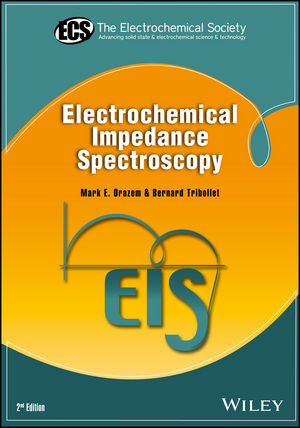 Electrochemical Impedance Spectroscopy (2nd Edition), by Mark E. Orazem and Bernard Tribollet, provides the fundamentals needed to apply impedance spectroscopy to a broad range of applications with emphasis on obtaining physically meaningful insights from measurements. The second edition provides expanded treatment of the influence of mass transport, time-constant dispersion, kinetics, and constant-phase elements.
 Ten new issues of ECS Transactions (ECST) have just been published for the upcoming 231st ECS Meeting. The papers in these issues of ECST will be presented in New Orleans, Louisiana, May 28 – June 1, 2017.