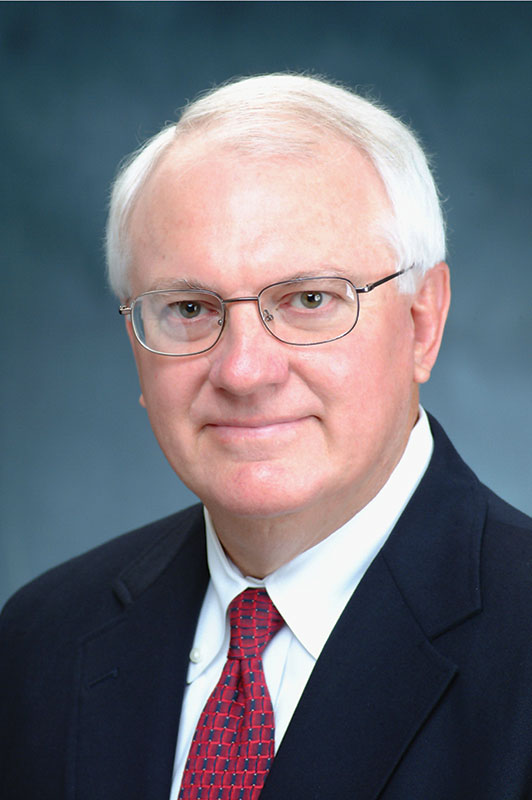
 Charles L. Hussey is Associate Dean for Research and Graduate Education in the College of Liberal Arts at the University of Mississippi and professor of chemistry. He is a fellow of ECS and a recipient of the Society’s Max Bredig Award in Molten Salt and Ionic Liquid Chemistry. His scientific research with molten salts/ionic liquids has been directed at the electrochemistry and spectroscopy of d- and f-block elements, the electrodeposition of aluminum and corrosion-resistant aluminum-transition metal alloys, the electrodissolution of metals and alloys, and the electrochemical processing of spent nuclear fuel. Hussey was recently reappointed as technical editor of the Journal of The Electrochemical Society in the area of electrochemical/electroless deposition.
The Electrochemial Society: What has your experiences as a JES editor been like?
Charles Hussey: I was appointed as an associate editor in 2000 and continued in that role until 2011. As an associate editor, I handled manuscripts on all topics for JES and Electrochemical and Solid-State Letters. Handling a variety of topical manuscripts for JES and ESL was the job that needed to be done, and it was a very challenging and sometimes uncomfortable assignment, but also highly educational.
 Submission Deadline: February 14, 2018
 Over 1,840 articles were published in ECS journals in 2017, ranging from battery technology to materials science. Among those articles, “
 United States President John F. Kennedy sent a powerful message to the country in his speech at Rice University in1962, “We choose to go to the Moon in this decade and do the other things, not because they are easy, but because they are hard; because that goal will serve to organize and measure the best of our energies and skills, because that challenge is one that we are unwilling to postpone, and one we intend to win.”
 In the Fall of 2011, Sarah Mackenzie, the maid of honor at my wedding, was diagnosed with a rare form of ovarian cancer. Sarah and her family were motivated to learn as much as they could about the disease to advocate for her care. They weren’t scientists, but they started searching the literature for relevant articles. One evening, Sarah called us, angry. Every time she found an article that might be relevant to understanding her disease, she ran into a paywall requiring $15-$40 to access it. Public money had paid for the research, yet she was barred from making any use of it. Luckily, she had us. Most people in Sarah’s position don’t have the luxury of friends at wealthy academic institutions with subscriptions to the literature.
 As of January 1, 2018, ECS will require all corresponding authors to have an