
 For months, Impact Canada has been working hard on narrowing down five finalists to work on the Charging the Future Challenge, a $4.5-million project aimed at accelerating made-in-Canada clean battery innovations with the potential to substantially reduce greenhouse gas emissions. The five selected finalists will have the opportunity to pitch their ideas for battery breakthroughs to a jury for a chance to win up to $700,000 each to develop battery prototypes over the course of 18-months, with the winner receiving a $1 million grand prize. (more…)
 On June 17, 2020, Dr. Arumugam Manthiram, winner of the 2020 Henry B. Linford Award for Distinguished Teaching, presented his talk on “Intricacies of High-Energy Cathodes for Lithium-Ion Batteries” via a live webinar presentation.
Dr. Manthiram’s talk covered the fundamental science behind the development of high-energy density cathodes for lithium-ion batteries in the 1980s, the richness and complexity of layered oxide cathodes for lithium-ion batteries, and exposure to a perspective on high-energy, long-life, safe lithium-ion batteries.
View Dr. Manthiram’s webinar presentation, here.
Following the talk, attendees were given the opportunity to ask Dr. Manthiram questions in a Q&A session, available below. (more…)
 Batteries—they’re all around us, from everyday items like cellphones and laptops to life-saving medical devices and environmentally-friendly electric vehicles. So, who are the people behind the batteries that continue to impact and improve our daily lives?
According to Research Interfaces, the following are the 10 lithium-ion battery researchers to watch. (more…)
 ECS is hosting a series of webinars presented by distinguished speakers this June. Join us! Speakers include Harry Atwater from the California Institute of Technology, Arumugam Manthiram from the University of Texas at Austin, and Paul Kenis from the University of Illinois at Urbana-Champaign. Topics include batteries, energy, carbon, and more. Considering attending? Learn more about what you can expect to hear about from our presenters! (more…)
 New, low-cost batteries designed to last for a million miles of use in electric vehicles? Tesla Chief Executive Elon Musk says the public can expect just that from the Model 3 sedan, expected to debut in China late this year or early next.
According to Reuters, the new “million mile” battery—which relies on low-cobalt and cobalt-free battery chemistries, among others—was jointly developed with China’s Contemporary Amperex Technology Ltd (CATL). Reuter’s sources say CATL plan on supplying Tesla with an improved long-life nickel-manganese-cobalt (NMC) battery whose cathode is 50% nickel and only 20% cobalt sometime next year. (more…)
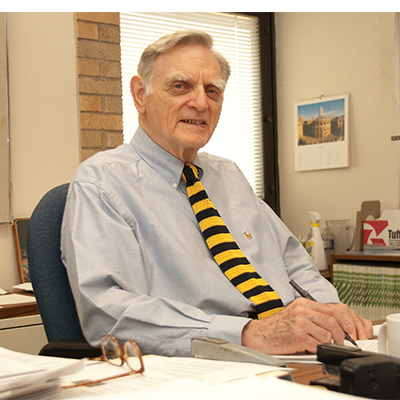 “Good enough” are just words in his last name, but not ones John B. Goodenough seems to live by. The 97-year-old, widely referred to as the “father of the lithium-ion batteries,” continues to awe the battery field. According to IEEE Spectrum, the 2019 Nobel Prize winner recently co-developed a rapid-charging, non-flammable, glass battery.
The high capacity battery charges in “minutes rather than hours,” according to Maria Helena Braga, professor of engineering at the University of Porto in Portugal, who worked with Goodenough to develop the solid state lithium rechargeable which uses a glass doped with alkali metals as the battery’s electrolyte. In addition, the solid state electrolyte is not flammable and preforms in both cold and hot weather. (more…)
Posted in Batteries
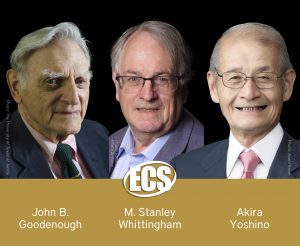 The Electrochemical Society honors 2019 Nobel Chemistry Prize laureates, John B. Goodenough, M. Stanley Whittingham, and Akira Yoshino, by the launch of a new collection highlighting their scientific contributions published by ECS. In addition, ECS recognizes their contributions in the winter 2019 issue of Interface, now available online.
Goodenough, Whittingham, and Yoshino have been deeply involved with The Electrochemical Society—as members, authors, editors, fellows, meeting participants and organizers, awardees, and more. Their publications with ECS, to varying degrees, trace the history of the development of the Lithium-ion battery, the revolutionary invention for which they shared the 2019 Nobel Prize in Chemistry. (more…)
 John Goodenough, Stanley Whittingham, and Akira Yoshino, co-winners of the 2019 Nobel Prize in Chemistry, delivered their Nobel Lectures at The Royal Swedish Academy of Sciences in Stockholm, Sweden, on December 8. The 2019 Nobel Prize in Chemistry recognized the three scientists’ seminal contributions in the development of the Lithium-ion battery. Goodenough, Whittingham, and Yoshino are longtime members of The Electrochemical Society (ECS); Goodenough and Whittingham are ECS Fellows.
The Nobel Foundation statutes require the Laureates to give lectures on a subject connected with the work for which the prize has been awarded.
John Goodenough had his pre-taped lecture delivered by Arumugam Manthiram on the topic of Designing Lithium-ion Cathodes.
Stanley Whittingham discussed The Origins of the Lithium Battery.
Akira Yoshino presented a Brief History and Future of Lithium-ion Batteries. (more…)

John B. Goodenough © Nobel Media. Photo: Alexander Mahmoud
As John B. Goodenough looked on, his Nobel Lecture was delivered by Arumugam Manthiram at the Aula Magna, Stockholm University, on December 8, 2019. Both Goodenough and Manthiram are fellows of The Electrochemical Society (ECS).
Nobel Laureates are required to give a lecture on a subject connected with the work for which they receive the award. Goodenough videotaped his lecture, “Designing Lithium-ion Battery Cathodes,” before December 8, then invited Manthiram to present it in Stockholm. Manthiram added explanations and comments between Goodenough’s slides and video, concluding with a summary of Goodenough’s research and its historical significance. The three classes of materials Goodenough discovered—layered oxide, spinel oxide, and polyanion oxide—still remain the only viable cathodes and the basis for future development. Goodenough pushed the boundaries of sold-state chemistry and physics. “His trump card is using chemistry and physics to solve engineering problems,” said Manthiram on another occasion. (more…)
236th ECS Meeting Best Poster and Presentation Winners
Posted on November 15, 2019 by Frances Chaves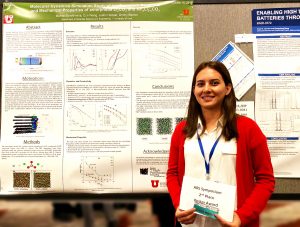
Mahsa Ebrahiminia (Photo by Gleb Yushin)
ECS is pleased to announce the winners of symposia-funded best presentation awards from the 236th ECS Meeting in Atlanta. Through the generous funding of individual symposium sponsors, several awards of this type are presented at every ECS meeting. You are invited to celebrate the excellent work of these authors:
A05 – Lithium Ion Batteries – Best Poster Award Winners
Thank you to Livent, Arbin Instruments, and Gamry Instruments, Inc. for their generous sponsorship of this symposium.
Mahsa Ebrahiminia, University of Utah: “Molecular Dynamics Simulation Study of Ion Transport, Structural and Mechanical Properties of Li2CO3 and Mn-Li-CO3” (more…)